
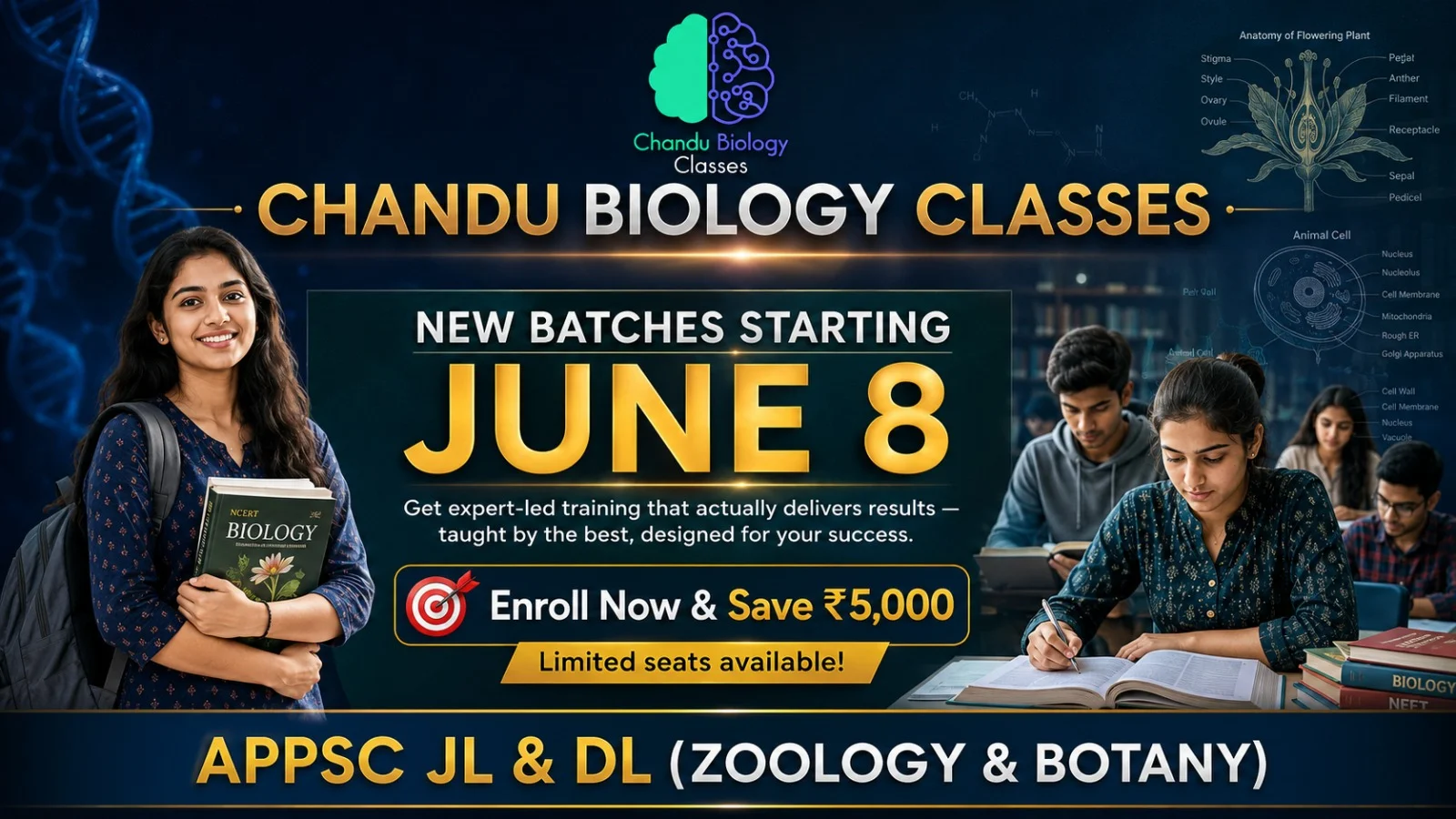
If you are preparing for the Andhra Pradesh Public Service Commission (APPSC) Lecturer recruitment exam, you already know that smart preparation beats hard preparation every single time. Thousands of candidates appear for this exam every year, but only those who understand the APPSC Lecturer Zoology Paper 2 weightage topics manage to clear the cutoff and secure a government lecturer position. This article is your complete, no-fluff guide to understanding which topics carry the most weight, how to allocate your study time, and where to get the best coaching support.
Whether you are a fresh postgraduate or a working professional attempting this exam, this guide will walk you through every high-priority area of Zoology Paper 2 so that you don’t waste a single hour on low-yield content.
What Is APPSC Lecturer Zoology Paper 2? A Quick Overview
The APPSC Lecturer in Government Degree Colleges exam is conducted to recruit qualified individuals for teaching positions under the Andhra Pradesh government. The exam structure includes a General Studies paper and a subject-specific paper — in this case, Zoology.
Paper 2 is the subject-specific paper that tests your deep conceptual understanding of Zoology at the postgraduate level. The questions are framed from a wide range of topics, but not all topics carry equal importance. Understanding which areas fetch you the most marks is the single biggest strategic advantage you can give yourself.
The exam is objective in nature, typically consisting of 150 questions for 150 marks, and the time allotted is generally 150 minutes. Every mark matters here, and eliminating wrong answers requires not just reading the topic but mastering it.
Why Topic Weightage Matters More Than You Think
Before diving into the actual topics, let’s understand why weightage analysis is so important.
Most students make the mistake of reading Zoology like a college textbook — from Chapter 1 to the last chapter, giving equal time to every unit. This approach is flawed when you are preparing for a competitive exam with a syllabus that spans over 15 major domains of biology.
When you study based on topic weightage:
- You identify which topics appear every single year without exception
- You stop wasting time on topics that have appeared only once in ten years
- You build your strongest areas stronger and your weak areas to at least a passing standard
- You can complete quality revision in the final weeks before the exam
This is exactly what Chandu Biology Classes trains its students to do — not just read, but prepare with purpose.
APPSC Lecturer Zoology Paper 2 Weightage Topics: Unit-Wise Breakdown
Here is a detailed breakdown of the most important and high-weightage topics from the APPSC Lecturer Zoology Paper 2 syllabus. These are based on previous year question paper analysis, syllabus pattern, and frequency of appearance.
1. Cell Biology and Molecular Biology — High Weightage ⭐⭐⭐⭐⭐
This is consistently one of the highest-scoring units in Paper 2. Questions from this section appear in almost every APPSC Lecturer exam and form the backbone of biological science at the postgraduate level.
Key topics to master:
- Cell structure and ultrastructure — nucleus, mitochondria, chloroplasts, ER, Golgi
- Cell cycle — mitosis and meiosis in complete molecular detail
- DNA replication — prokaryotic vs eukaryotic mechanisms
- Transcription and translation — from operon models to post-translational modifications
- Gene regulation — lac operon, trp operon, eukaryotic gene regulation
- Signal transduction pathways
- Apoptosis — intrinsic and extrinsic pathways
- Chromatin structure and epigenetic regulation
Students who can answer 10 to 12 questions from this unit alone are already in a strong position. Invest at least 15 to 20 percent of your total preparation time here.
2. Genetics and Evolution — High Weightage ⭐⭐⭐⭐⭐
Genetics is a subject where the questions range from classical Mendelian problems to advanced molecular genetics. Both ends of the spectrum appear in APPSC Paper 2.
Key topics to master:
- Mendelian genetics and its extensions — incomplete dominance, codominance, epistasis, pleiotropy
- Chromosomal theory of inheritance
- Linkage, crossing over, and chromosome mapping
- Sex determination and sex-linked inheritance
- Mutation — types, molecular basis, repair mechanisms
- Population genetics — Hardy-Weinberg equilibrium, genetic drift, gene flow
- Evolutionary theories — Lamarckism, Darwinism, Neo-Darwinism, synthetic theory
- Speciation mechanisms — allopatric, sympatric, parapatric
- Molecular phylogenetics and cladistics
Questions from genetics and evolution together can account for 15 to 20 questions easily. Never skip this unit.
3. Biochemistry — High Weightage ⭐⭐⭐⭐
Biochemistry questions are not always the most popular among students, but they are highly predictable and very scoring once you understand the patterns.
Key topics to master:
- Structure and function of biomolecules — proteins, carbohydrates, lipids, nucleic acids
- Enzyme kinetics — Michaelis-Menten equation, enzyme inhibition, allosteric regulation
- Metabolism — glycolysis, TCA cycle, oxidative phosphorylation, electron transport chain
- Fatty acid metabolism — beta oxidation, synthesis
- Amino acid metabolism and urea cycle
- Photosynthesis — light and dark reactions, C3, C4, CAM pathways
- Vitamins and their role as coenzymes
- Bioenergetics and ATP synthesis
Biochemistry and molecular biology together form the conceptual foundation of modern zoology at the PG level. Expect 12 to 18 questions from these two areas combined.
4. Animal Physiology — High to Medium Weightage ⭐⭐⭐⭐
Animal physiology is practical, concept-heavy, and a direct extension of what zoology students study throughout their undergraduate and postgraduate years.
Key topics to master:
- Nerve impulse — resting membrane potential, action potential, synaptic transmission
- Muscle physiology — sliding filament theory, neuromuscular junction, types of muscle fibers
- Digestive physiology — enzymes, absorption mechanisms, gut hormones
- Respiratory physiology — oxygen dissociation curve, Bohr effect, gas transport
- Renal physiology — nephron structure, filtration, reabsorption, countercurrent mechanism
- Endocrine system — hormones, their mechanisms of action, feedback loops
- Cardiovascular physiology — heart physiology, blood pressure regulation
- Thermoregulation — ectotherms vs endotherms
- Reproductive physiology — gametogenesis, fertilization, implantation
Animal physiology is one of the most conceptually rich sections and rewards students who understand mechanisms rather than just memorize facts.
5. Developmental Biology (Embryology) — Medium to High Weightage ⭐⭐⭐⭐
Developmental biology has been gaining increasing importance in APPSC exams, especially with questions now probing molecular aspects of development.
Key topics to master:
- Gametogenesis — spermatogenesis and oogenesis in detail
- Fertilization mechanisms — acrosome reaction, cortical reaction, polyspermy prevention
- Cleavage patterns and types of eggs
- Gastrulation — fate maps, germ layer formation
- Organogenesis — neurulation, somitogenesis, limb development
- Induction and competence
- Developmental genetics — homeotic genes, HOX genes, segmentation genes in Drosophila
- Stem cells — types and therapeutic applications
- Regeneration and aging
Pay special attention to the molecular aspects of development — these are increasingly tested at APPSC level.
6. Immunology — Medium Weightage ⭐⭐⭐
Immunology questions are focused and predictable. Students either master this section completely or skip it entirely — the smart move is to master it.
Key topics to master:
- Innate vs adaptive immunity
- Cells of the immune system — T cells, B cells, NK cells, macrophages, dendritic cells
- Antigen processing and presentation — MHC class I and II
- Antibody structure, classes, and functions
- Complement system — classical, alternative, and lectin pathways
- Hypersensitivity reactions — Type I to IV
- Autoimmunity and immunodeficiency disorders
- Vaccines — types and mechanisms
Immunology questions are usually straightforward if you have studied the topic well. Expect 6 to 10 questions from this section.
7. Ecology and Environmental Biology — Medium Weightage ⭐⭐⭐
Ecology is a broad area and questions are sometimes unpredictable, but certain subtopics appear consistently.
Key topics to master:
- Ecological levels — individual, population, community, ecosystem, biosphere
- Population ecology — growth models, carrying capacity, age pyramids
- Community ecology — succession, species diversity, competition, predation, mutualism
- Ecosystem ecology — energy flow, trophic levels, food chains and webs
- Biogeochemical cycles — nitrogen, carbon, phosphorus cycles
- Biomes — characteristics and distribution
- Environmental pollution — types, effects, control measures
- Biodiversity — types, hotspots, threats, conservation strategies
- Wildlife conservation in India — national parks, sanctuaries, biosphere reserves
Ecology has both static and dynamic components. The static parts (names, locations, facts) can be learned quickly, while the conceptual parts (population models, energy flow) need more time.
8. Biotechnology — Medium Weightage ⭐⭐⭐
Biotechnology has grown into a significant section in modern APPSC Lecturer exams. Questions here are both conceptual and application-based.
Key topics to master:
- Recombinant DNA technology — restriction enzymes, vectors, cloning strategies
- PCR — types and applications
- DNA sequencing methods — Sanger, next-generation sequencing
- Gene expression systems — prokaryotic and eukaryotic
- Transgenic animals — methods and applications
- CRISPR-Cas9 gene editing
- Hybridoma technology and monoclonal antibodies
- Bioinformatics basics — BLAST, sequence alignment, databases
- Biosafety and bioethics
Biotechnology is a rapidly evolving field and the questions in APPSC increasingly reflect current developments. Stay updated.
9. Systematics and Taxonomy — Low to Medium Weightage ⭐⭐
While systematics forms the backbone of classical zoology, its representation in Paper 2 is relatively moderate.
Key topics to master:
- Principles of classification — phenetic vs cladistic approaches
- Nomenclature rules — ICZN
- Major phyla — distinguishing characters and economic importance
- Protozoa, Porifera, Cnidaria, Platyhelminthes, Nematoda, Annelida, Arthropoda, Mollusca, Echinodermata, Chordata
- Non-chordates vs chordates — key differences
- Vertebrate classification — fish, amphibians, reptiles, birds, mammals
Systematics questions are usually straightforward and factual, making them easy marks if you have revised well.
10. Parasitology — Low Weightage ⭐⭐
Parasitology has limited but consistent representation.
Key topics to master:
- Host-parasite relationships
- Life cycles of major parasites — Plasmodium, Entamoeba, Wuchereria, Ascaris, Fasciola, Taenia
- Vectors and mode of transmission
- Control measures and public health significance
These are mostly factual questions that can be answered quickly once you have memorized the life cycles.
APPSC Lecturer Zoology Paper 2 Weightage Topics: Priority Table
| Unit | Approximate Weightage | Priority Level |
|---|---|---|
| Cell Biology & Molecular Biology | 12–15% | Must Prepare |
| Genetics & Evolution | 12–15% | Must Prepare |
| Biochemistry | 10–12% | Must Prepare |
| Animal Physiology | 10–12% | Must Prepare |
| Developmental Biology | 8–10% | High Priority |
| Immunology | 6–8% | High Priority |
| Biotechnology | 6–8% | High Priority |
| Ecology & Environment | 8–10% | Medium Priority |
| Systematics & Taxonomy | 5–7% | Medium Priority |
| Parasitology | 3–5% | Low Priority |
How to Create a Study Plan Based on Weightage
Understanding the weightage is only half the battle. Translating that knowledge into an effective study plan is what separates the rankers from the rest.
Here is a practical approach:
Phase 1 — Foundation (Months 1 and 2): Focus exclusively on Cell Biology, Molecular Biology, Genetics, and Biochemistry. These are your anchor units. Every day spent here compounds into significant marks.
Phase 2 — Core Building (Months 3 and 4): Move to Animal Physiology, Developmental Biology, and Immunology. These sections reward students who understand mechanisms and can apply concepts to unfamiliar scenarios.
Phase 3 — Breadth Coverage (Month 5): Cover Biotechnology, Ecology, Systematics, and Parasitology. Use this phase to also start solving previous year question papers topic-wise.
Phase 4 — Revision and Mock Tests (Month 6 onwards): Stop reading new content. Focus entirely on revision, mock tests, and analyzing your weak areas. Write at least two full-length mock tests per week.
Why Chandu Biology Classes Is the Best Choice for APPSC Lecturer Zoology Preparation
Preparing alone is possible, but preparing smart is significantly easier with the right guidance. Chandu Biology Classes has emerged as one of the most trusted names in Zoology competitive exam coaching in Andhra Pradesh and Telangana.
Here is what makes Chandu Biology Classes stand out:
Expert Faculty with Deep Subject Knowledge: The coaching is led by subject matter experts who have a thorough understanding of the APPSC Lecturer exam pattern, previous year question trends, and the exact depth at which each topic needs to be studied.
Topic-Wise Weightage Analysis: Rather than teaching the entire syllabus in a linear, textbook manner, Chandu Biology Classes provides students with detailed weightage analysis and helps them prioritize their preparation intelligently. This is especially valuable for topics like the APPSC Lecturer Zoology Paper 2 weightage topics covered in this article.
Comprehensive Study Material: The study materials are curated specifically for APPSC and related state PSC exams. You won’t find generic notes — every page is written keeping the exam pattern in mind.
Regular Mock Tests and Previous Year Paper Analysis: Chandu Biology Classes conducts regular mock tests, sectional tests, and full-length practice papers. The test series is designed to mirror the actual exam environment, helping students build both speed and accuracy.
Doubt Clearing and Personal Attention: Every student’s learning pace is different. Chandu Biology Classes offers regular doubt-clearing sessions to ensure no student is left behind.
Proven Track Record: Many students who have cleared the APPSC Lecturer exam in Biology and Zoology have been associated with Chandu Biology Classes. Their success is a direct reflection of the quality of coaching offered.
Chandu Biology Classes Fee Structure
If you are considering enrolling in Chandu Biology Classes for your APPSC Lecturer Zoology preparation, here is the current fee structure:
| Mode of Learning | Fee |
|---|---|
| Online Classes | ₹25,000 |
| Offline Classes | ₹30,000 |
The online batch is ideal for students who are located outside Andhra Pradesh or Telangana, or those who prefer flexibility in their study schedule. The offline batch provides an immersive classroom experience with direct interaction with faculty.
Both modes include access to study material, mock tests, and doubt-clearing sessions. Given the level of preparation required for a government lecturer position, the investment is well worth the return.
Common Mistakes Students Make While Preparing Paper 2
Knowing what to do is important. Knowing what not to do is equally critical.
Mistake 1 — Studying Without a Syllabus: Always keep the official APPSC Lecturer Zoology syllabus in front of you. Never study from random sources without mapping the content to the syllabus.
Mistake 2 — Ignoring Previous Year Papers: Previous year question papers are your single most valuable resource. They reveal the exact depth of questioning, the language patterns used, and the topics that repeat year after year.
Mistake 3 — Skipping Molecular Topics: Many students with a classical zoology background find molecular topics intimidating and avoid them. This is a costly mistake. Cell biology, molecular biology, and genetics together account for nearly 30 percent of Paper 2.
Mistake 4 — Not Practicing Multiple Choice Format: Reading and understanding is different from answering MCQs under time pressure. Practice the MCQ format regularly from the beginning of your preparation.
Mistake 5 — Preparing Too Many Sources: Focus on 2 to 3 standard textbooks and your coaching materials. Jumping between 8 different books creates confusion and wastes valuable revision time.
Best Books for APPSC Lecturer Zoology Paper 2
Here are the standard reference books that align with the APPSC syllabus:
- Cell and Molecular Biology — De Robertis and De Robertis
- Molecular Biology of the Cell — Alberts et al.
- Lehninger Principles of Biochemistry — Nelson and Cox
- Genetics — Strickberger or Lewin’s Genes
- Animal Physiology — Eckert, Randall and Augustine
- Developmental Biology — Gilbert
- Immunology — Janeway’s Immunobiology or Kuby
- Ecology — Odum’s Fundamentals of Ecology
- Biotechnology — B.D. Singh or Glick and Pasternak
Use these books as reference material. Your primary study source should remain your coaching notes and APPSC-specific material from Chandu Biology Classes.
Frequently Asked Questions (FAQs)
Q1. What are the most important topics in APPSC Lecturer Zoology Paper 2?
The most important topics based on previous year question paper analysis are Cell Biology, Molecular Biology, Genetics, Biochemistry, and Animal Physiology. Together, these five areas account for nearly 50 to 55 percent of the total questions in Paper 2. Students must treat these as non-negotiable priorities in their preparation.
Q2. How many questions come from each unit in APPSC Lecturer Zoology Paper 2?
While the exact distribution varies from year to year, approximately 12 to 15 questions come from Cell and Molecular Biology, 12 to 15 from Genetics and Evolution, 10 to 12 from Biochemistry, and 10 to 12 from Animal Physiology. Developmental Biology, Immunology, and Biotechnology contribute 6 to 10 questions each. Ecology, Systematics, and Parasitology contribute the remaining questions.
Q3. Is Chandu Biology Classes good for APPSC Lecturer Zoology preparation?
Yes, Chandu Biology Classes is widely regarded as one of the best coaching institutes for APPSC Lecturer Zoology preparation. They provide topic-wise weightage analysis, curated study materials, regular mock tests, and personalized doubt-clearing support. The fee is ₹25,000 for online classes and ₹30,000 for offline classes, making it accessible for students across both modes of learning.
Q4. What is the difficulty level of APPSC Lecturer Zoology Paper 2?
The difficulty level of APPSC Lecturer Zoology Paper 2 is moderate to high, equivalent to the postgraduate level of study. Questions test both factual knowledge and conceptual understanding. Molecular biology and biochemistry questions tend to be more challenging, while systematics and parasitology questions are more straightforward and factual.
Q5. How long does it take to prepare for APPSC Lecturer Zoology?
For a serious candidate dedicating 6 to 8 hours of focused study per day, 6 to 8 months of preparation is generally considered sufficient. However, candidates who are already working or have other commitments may need 10 to 12 months. The key is consistent, structured preparation based on topic weightage rather than random reading.
Q6. Can I crack APPSC Lecturer Zoology without coaching?
Self-study is possible, but challenging given the breadth and depth of the syllabus. Having structured coaching from an institute like Chandu Biology Classes significantly reduces preparation time and improves accuracy. Coaching provides you with curated materials, proven strategies, and the discipline of a structured schedule — all of which are difficult to replicate independently.
Q7. What is the syllabus for APPSC Lecturer Zoology Paper 2?
The APPSC Lecturer Zoology Paper 2 syllabus broadly covers Cell Biology, Molecular Biology, Genetics, Biochemistry, Animal Physiology, Developmental Biology, Immunology, Ecology, Biotechnology, Systematics, and Parasitology — all at the postgraduate level. Students should download the official APPSC syllabus from the commission’s official website and map every topic they study to the syllabus.
Q8. Are there negative marks in APPSC Lecturer Zoology Paper 2?
Yes, APPSC Lecturer exams generally carry a negative marking scheme. Typically, one-third of the marks allotted to a question are deducted for every wrong answer. This makes it crucial to attempt only those questions you are reasonably confident about rather than attempting all questions blindly.
Q9. What is the cutoff for APPSC Lecturer Zoology?
The cutoff for APPSC Lecturer Zoology varies each year depending on the number of vacancies, the number of candidates who appeared, and the overall difficulty of the paper. While official cutoffs are declared by APPSC after each exam cycle, generally the competitive range has been between 55 and 70 percent for general category candidates in recent years.
Q10. How is APPSC Lecturer Paper 2 different from TSPSC Lecturer Zoology Paper 2?
Both APPSC and TSPSC Lecturer exams follow similar syllabus structures rooted in postgraduate Zoology. However, the question difficulty, paper pattern, and specific topic emphasis can vary. Students in Andhra Pradesh should focus specifically on APPSC patterns, while Telangana students should focus on TSPSC. Coaching institutes like Chandu Biology Classes offer preparation for both these exams.
Final Thoughts: Strategy Is Everything
Let’s end with the most important message of this entire article — knowing the APPSC Lecturer Zoology Paper 2 weightage topics is not enough. Acting on that knowledge, daily and consistently, is what will get your name on the final merit list.
The APPSC Lecturer position is prestigious, permanent, and comes with all the benefits of a state government job. Competition is real, but so is opportunity. Every year, deserving candidates who prepared strategically clear this exam. You can be one of them.
Map your preparation to the weightage. Start with the high-priority units — Cell Biology, Genetics, Biochemistry, Physiology. Build a strong foundation there before spreading into other topics. Use previous year papers relentlessly. Get your doubts cleared from expert faculty.
If you are looking for structured, expert guidance, Chandu Biology Classes with its online batch at ₹25,000 and offline batch at ₹30,000 offers one of the most complete and affordable preparation platforms for this exam. Enroll, commit to the process, and trust the preparation.
Your goal is to walk into that exam hall with confidence — and the only way to build that confidence is through consistent, intelligent preparation.
Good luck. The government lecture chair has your name on it — you just have to earn
