
The Dream That Thousands of Biology Postgraduates Share — And How to Actually Achieve It
Picture this.
You walk into a government degree college classroom in Andhra Pradesh. Sixty students look up at you. You are not there on a temporary contract. You are not worried about your next paycheck. You are a permanent government lecturer — with job security, a UGC pay scale salary, a pension, and the respect that comes with shaping young scientific minds for decades.
For every postgraduate in Botany and Zoology across Andhra Pradesh, this is the dream. Thousands work toward it every year. But only a fraction actually get selected.
Why? Not because they lacked intelligence. Not because the subject was too hard. But because they did not have a clear roadmap, they did not understand the exam deeply enough, and they were not guided by people who have actually been through this process.
This article changes that.
Whether you just completed your MSc in Botany or Zoology, or whether you have been appearing for government exams for a while and cannot figure out what is going wrong — this is the most complete, honest, and actionable guide to becoming a government lecturer in Andhra Pradesh through the APPSC Junior Lecturer examination.
Read it fully. It will take you twenty minutes. Those twenty minutes could redirect the next twenty years of your career.
First, Understand What the APPSC JL Exam Actually Is
The Andhra Pradesh Public Service Commission (APPSC) conducts recruitment for Junior Lecturers in Government Degree Colleges under the A.P. Collegiate Education Service. These are permanent teaching posts in government-run undergraduate colleges across all four zones of Andhra Pradesh.
The most recent recruitment cycle — Notification No. 17/2023 dated 30th December 2023 — announced 290 total vacancies across 14 subjects. Among them, Botany and Zoology each carry 20 vacancies, making them two of the most sought-after Life Sciences posts in this recruitment.
This is not a temporary or contractual appointment. This is a Class I state government service post with full benefits, permanency, and UGC pay scales. The competition is intense — but the reward is a career that most people only dream about.
Who Is Eligible? The Non-Negotiable Requirements
Before anything else, you must confirm your eligibility. Many aspirants waste months preparing only to discover they are ineligible on a technicality. Do not let that be you.
Academic Qualification
You must hold a Master’s degree in Botany or Zoology (as applicable) from a recognized Indian university with a minimum of 55% marks — which corresponds to Grade B in the UGC 7-point scale (O, A, B, C, D, E, F).
Relaxations:
- SC/ST candidates: 50% is sufficient at PG level
- Ph.D. holders who completed their Master’s before 19th September 1991: 50% is sufficient
NET or SLET — The Most Misunderstood Requirement
This is where many aspirants trip up.
NET or SLET is compulsory for APPSC JL. You must have cleared the National Eligibility Test conducted by UGC or CSIR, or the State Level Eligibility Test (SLET) conducted by the university.
However — and this is important — if you hold a Ph.D. degree awarded in compliance with UGC (Minimum Standards and Procedure for Award of Ph.D. Degree) Regulations, 2009, you are fully exempt from NET/SLET.
So if you are a non-NET MSc graduate, the two paths forward are:
- Clear NET/SLET as soon as possible
- Pursue a Ph.D. under UGC 2009 regulations, which exempts you entirely
Age Limit
- Minimum: 18 years
- Maximum: 42 years as on 01/07/2023
Age relaxations available:
- SC, ST, BC, EWS: 5 additional years
- Persons with Benchmark Disabilities: 10 additional years
- Ex-Servicemen: Length of service + 3 years
- Regular AP State Government Employees: Up to 5 years
Citizenship
You must be a citizen of India.
The Salary That Makes Every Hour of Preparation Worth It
Let us talk money — because knowing what you are working toward makes the preparation more meaningful.
The pay scale for APPSC Junior Lecturer is:
Rs. 57,700 – Rs. 1,82,400 (Academic Level 10, Revised UGC Pay Scale 2016)
At the entry level, your gross monthly salary including HRA, DA and other allowances typically works out to approximately Rs. 70,000 to Rs. 80,000 per month depending on the posting location. This grows significantly with each pay revision and time-bound increment.
Beyond the salary, government lecturers in Andhra Pradesh receive:
- Dearness Allowance (DA) — revised periodically
- House Rent Allowance (HRA)
- Medical benefits under the state government health scheme
- Pension under the applicable retirement scheme
- Leave encashment and other service benefits
- Long vacation periods that align with college academic calendars
- Job permanency that no private sector position can offer
When you calculate the total lifetime value of this career — salary, benefits, pension, security and social respect — the APPSC JL position is worth well over Rs. 3 to 4 crore in total career earnings for a person who joins at 28 and retires at 60.
That is what you are preparing for. Every hour of study has that value behind it.
Understanding the Exam Structure — The Paper You Cannot Afford to Underestimate
The APPSC JL examination consists of two papers, both objective type and conducted via Computer Based Test (CBT):
Paper 1: General Studies and Mental Ability
- Degree Standard
- 150 Questions — 150 Marks — 150 Minutes
- Topics: Current Affairs (International, National, AP-specific), General Science, Indian History, Geography of India (focus on AP), Indian Polity and Governance, Indian Economy, Environmental Science, Disaster Management, Logical Reasoning, Data Analysis
Paper 2: Concerned Subject (Botany or Zoology)
- PG Standard — this is the decisive paper
- 150 Questions — 300 Marks — 150 Minutes
- Questions are drawn from the complete PG syllabus of your subject
Total: 450 Marks
Negative Marking: 1/3rd of marks deducted for every wrong answer. This rule significantly changes preparation and exam strategy.
After Written Test: Shortlisted candidates appear for a Computer Proficiency Test (CPT). This is qualifying in nature — clear it, and your written exam rank determines your selection.
Minimum Qualifying Marks (Aggregate):
- OC/EWS/Ex-Servicemen/Sports Persons: 40%
- Backward Classes: 35%
- SC/ST/PBDs: 30%
The Critical Insight Most Aspirants Miss
Paper 2 carries double the marks of Paper 1. Scoring high in Paper 2 is the primary determinant of selection. But — and this is crucial — Paper 1 is where close competitors get separated. In any exam where top candidates cluster within a few marks of each other, your Paper 1 score can be the deciding factor.
Neglect Paper 1 at your peril.
The Syllabus Reality — Why Most Self-Studiers Struggle
Here is an honest assessment of the APPSC JL Zoology and Botany syllabi that most coaching institutes will not tell you:
The Paper 2 syllabus is enormous.
For Botany, it covers nine major units spanning Cell and Molecular Biology, Cytology and Genetics, Cryptogams, Taxonomy of Seed Plants, Plant Physiology and Metabolism, Plant Development, Plant Ecology, Resource Utilization and Conservation, and Plant Biotechnology.
For Zoology, it covers eleven major units spanning General Concepts, Non-Chordata, Chordata, Cell Biology, Genetics, System Physiology, Evolution, Developmental Biology, Histology, Ecology, and Immunology.
Each of these units, treated individually, is equivalent to a full semester paper in a postgraduate program. Together, they represent the entire breadth of a Botany or Zoology Masters curriculum.
This creates a specific and common problem for self-study candidates: they run out of time. They start strong, cover the first three or four units in depth, and then realize with growing panic that the exam is approaching and six more units are barely touched. They start skipping topics, hoping the exam will not cover them — and it does.
The solution is not to study harder. The solution is to study smarter with structured guidance.
The Five Mistakes That Stop Botany and Zoology Aspirants From Getting Selected
After speaking to and coaching hundreds of APPSC JL aspirants, the same five mistakes appear again and again. Avoid these and you are already ahead of the competition:
Mistake 1: Treating Paper 2 as an Extension of Their MSc Exams
MSc university exams test depth in a few topics. APPSC JL Paper 2 tests breadth across the entire PG curriculum with MCQ precision. The skills are different. Descriptive writing ability means nothing here. What matters is the ability to recall exact facts, mechanisms and definitions quickly and accurately under time pressure.
Mistake 2: Completely Ignoring Paper 1
Many Life Sciences postgraduates feel uncomfortable with Current Affairs, Polity and Economy. They avoid Paper 1 preparation entirely and then lose selection to a candidate with a marginally lower Paper 2 score who had a significantly higher Paper 1 score.
Mistake 3: Studying Without a Time-Bound Syllabus Plan
Walking into APPSC JL preparation without a week-by-week schedule is like starting a journey without a map. You will wander, waste time on comfortable topics, and leave critical units untouched.
Mistake 4: Not Practicing Negative Marking Strategy
In their practice sessions, most candidates attempt every question. In the actual exam with 1/3rd negative marking, this approach can reduce your score by 20 to 40 marks. Knowing when to attempt and when to skip is a skill that must be deliberately practiced.
Mistake 5: Waiting for the “Perfect Time” to Start
There is no perfect time. If you are eligible and interested, start today. The candidates who will be selected in the next recruitment cycle are already preparing right now.
What a Winning Preparation Strategy Actually Looks Like
Here is a practical, proven preparation framework for APPSC JL Botany and Zoology:
Phase 1 — Orientation (Week 1 to 2)
- Download the official notification and read every word
- Map the complete syllabus of Paper 2 onto a topic list
- Assess your current knowledge level per unit honestly
- Enroll in a structured coaching program or build a rigid self-study schedule
Phase 2 — Systematic Syllabus Coverage (Months 1 to 4)
- Cover one major unit per week for Paper 2
- Devote 1 hour daily to Paper 1 topics (current affairs, polity, economy)
- Make concise unit-wise notes for rapid revision
- After each unit, solve at least 50 MCQs from that topic to test retention
For Botany aspirants — prioritize in this order:
- Plant Physiology and Metabolism
- Cell and Molecular Biology
- Genetics and Cytogenetics
- Plant Biotechnology
- Cryptogams
- Taxonomy of Seed Plants
- Plant Development
- Plant Ecology
- Resource Utilization and Conservation
For Zoology aspirants — prioritize in this order:
- Cell Biology
- Genetics
- Non-Chordata (especially Parasitology)
- System and Cell Physiology
- Immunology
- Developmental Biology
- Chordata
- Ecology
- Evolution
- Histology
- General Concepts
Phase 3 — Intensive Revision (Month 5)
- Revise all units using your notes
- Attempt full-length mock papers under timed, CBT-simulated conditions
- Analyze every mistake — was it a knowledge gap or a strategy error?
- Focus heavily on weak units identified during mock tests
Phase 4 — Final Sharpening (Last 2 Weeks Before Exam)
- No new topics
- Rapid revision of notes only
- One full mock test every two days
- Sleep, nutrition and mental preparation are as important as study
The Role of Coaching: When Self-Study Is Not Enough
Here is the uncomfortable truth: for most working adults and recent graduates juggling multiple responsibilities, self-study alone is insufficient for APPSC JL Botany or Zoology.
Not because they are not smart enough. But because:
- The syllabus is too vast to navigate without expert direction on what matters most
- PG-level MCQ preparation requires a different type of teaching than university exams
- Motivation and consistency are far harder to maintain alone than with a peer group and instructor
- Identifying your weak areas requires external assessment, not self-assessment
This is why the right coaching institute can be the single biggest factor in whether you clear this exam or keep attempting it year after year.
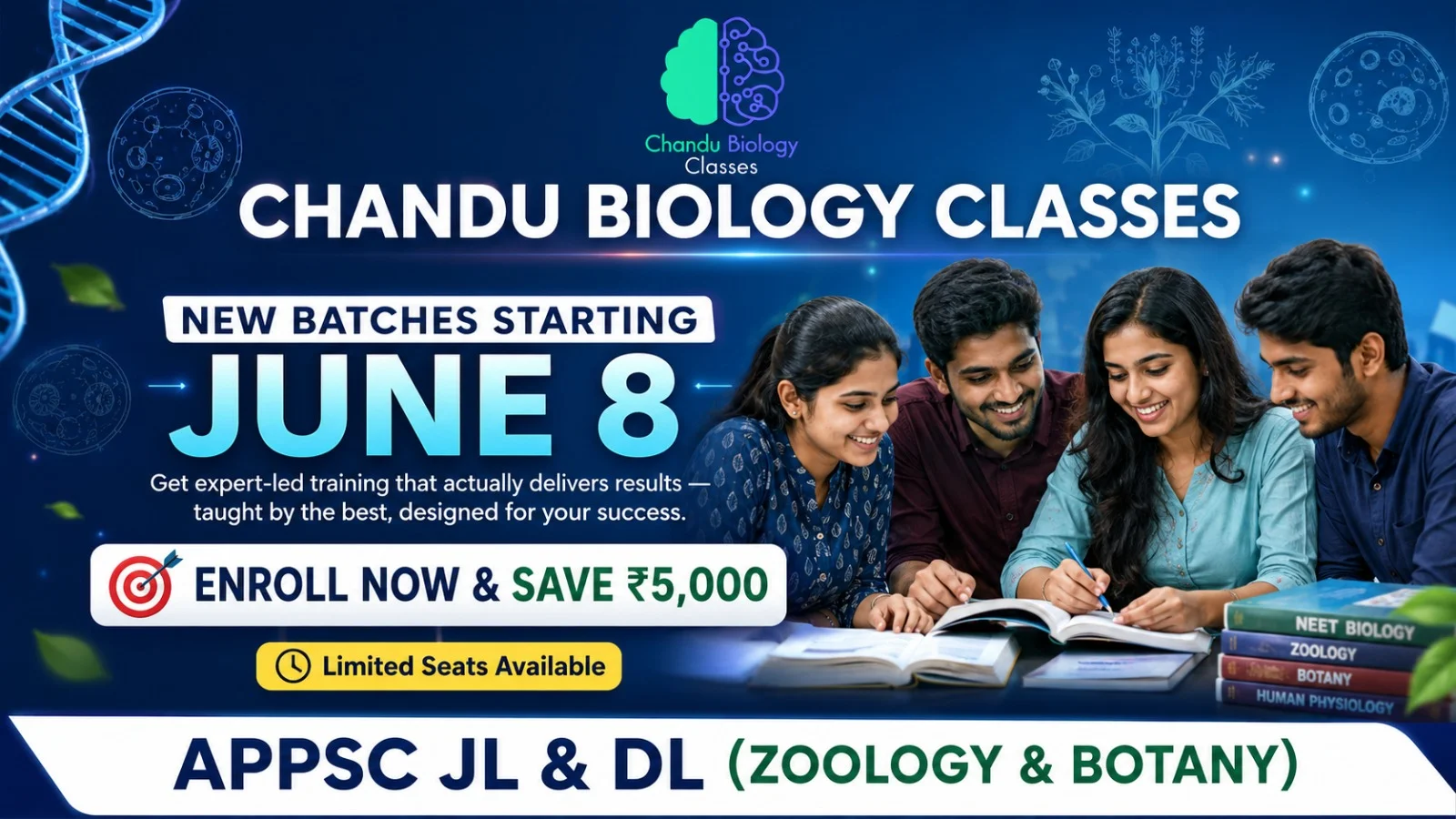
Why Chandu Biology Classes Is the Answer for APPSC JL Botany and Zoology Aspirants
Chandu Biology Classes was built specifically for Life Sciences aspirants preparing for APPSC JL Botany, APPSC JL Zoology, GATE Life Sciences and related competitive examinations in Andhra Pradesh.
This is not a general coaching institute that happens to offer biology. This is a specialist institution whose entire focus is on exactly the exams you are preparing for.
What Sets Chandu Biology Classes Apart
Deep Subject Expertise at PG Level The faculty at Chandu Biology Classes teach at the standard the APPSC actually demands — PG level, MCQ-focused, mechanism-oriented. You will not be getting simplified undergraduate-level explanations of PG topics. You will be getting the depth that Paper 2 requires.
Complete Syllabus Coverage — Every Unit, Every Topic From Cell Biology and Genetics to Ecology and Immunology for Zoology; from Plant Physiology and Molecular Biology to Plant Biotechnology and Taxonomy for Botany — every official topic on the APPSC JL syllabus is covered. Nothing is skipped. Nothing is glossed over.
Exam-Strategy Integration Understanding the subject is necessary. Translating that understanding into correct MCQ responses under time pressure and negative marking is a different skill. Chandu Biology Classes builds both — subject mastery and examination intelligence.
Structured Study Material Students receive dedicated, exam-aligned study material that maps directly to the official APPSC syllabus. This eliminates the time wasted in collecting, filtering and organizing resources from multiple sources — a process that consumes weeks for self-studiers and often produces incomplete coverage.
Paper 1 Preparation Included General Studies and Mental Ability is integrated into the coaching program. Students are not left to figure out Paper 1 on their own.
Community of Serious Aspirants Preparing alongside others who share your goal is one of the most powerful and underrated advantages of classroom learning. The peer accountability, the shared resources, the competitive energy — these are things a textbook and YouTube videos cannot provide.
Fee Structure — Transparent and Accessible
| Mode | Fee |
|---|---|
| Online Classes | Rs. 25,000 |
| Offline Classes | Rs. 30,000 |
This fee structure is designed to make professional, expert coaching accessible to aspirants across all four zones of Andhra Pradesh — whether you are in Visakhapatnam, Vijayawada, Guntur, Kurnool or anywhere in between.
APPSC JL vs Other Life Sciences Competitive Exams — How They Compare
Many aspirants prepare for multiple exams simultaneously. Here is how APPSC JL stacks up against the other major options:
| Exam | Standard | Salary | Permanency | Competition Level |
|---|---|---|---|---|
| APPSC JL Botany/Zoology | PG Level MCQ | Rs. 57,700 – 1,82,400 | Permanent State Service | High |
| GATE Life Sciences | PG Level | Varies (PSU/PhD) | Depends on use | Very High |
| UGC NET | PG Level | Varies (Assistant Professor) | Depends on institution | Very High |
| TSPSC JL (Telangana) | PG Level MCQ | Similar to APPSC | Permanent | High |
The smart move: APPSC JL and GATE Life Sciences share approximately 60 to 70% syllabus overlap. Preparing seriously for APPSC JL with a focus on conceptual depth simultaneously strengthens your GATE preparation. Chandu Biology Classes leverages this overlap, giving students a dual-exam advantage without doubling their preparation effort.
Frequently Asked Questions — What Serious Aspirants Actually Search For
Q1. Can I apply for both APPSC JL Botany and APPSC JL Zoology? Yes, if you hold PG degrees in both subjects and meet all eligibility criteria for each. You must submit separate applications with separate fees for each subject.
Q2. How many attempts are allowed for APPSC JL? There is no limit on attempts for APPSC JL, as long as you remain within the maximum age limit of 42 years.
Q3. Is the APPSC JL exam held every year? No. APPSC JL recruitment is conducted when the Commissioner of Collegiate Education reports vacancies to the Commission. It is not on a fixed annual cycle. This makes every notification precious — and preparation that is already in progress critically important.
Q4. Can I prepare for APPSC JL while working? Yes, many successful candidates have prepared while working. The key is a structured daily schedule — typically 3 to 4 focused hours per day — and a coaching program that provides organized, efficient preparation rather than requiring you to build your study structure from scratch.
Q5. How long does it take to prepare for APPSC JL Botany or Zoology? A candidate starting from a solid MSc foundation typically needs 5 to 7 months of structured preparation to be competitive. A candidate who has been away from the subject for several years may need 8 to 10 months. Starting early and maintaining consistency matters far more than the total duration.
Q6. What is the difference between Online and Offline coaching at Chandu Biology Classes? Online coaching (Rs. 25,000) provides live or recorded classes accessible from anywhere in Andhra Pradesh or beyond. Offline coaching (Rs. 30,000) provides in-person classroom instruction with direct faculty interaction. Both cover the complete APPSC JL syllabus with the same depth and study material.
Q7. What happens after the written exam in APPSC JL? After the written exam, APPSC publishes a merit list of candidates shortlisted for the Computer Proficiency Test (CPT). CPT is qualifying — you must pass it, but your written exam rank determines your final selection order. Zone allocation is made based on candidate preference at the time of certificate verification.
Q8. I have a Ph.D. in Botany but no NET. Am I eligible for APPSC JL Botany? Yes — provided your Ph.D. was awarded in compliance with the UGC (Minimum Standards and Procedure for Award of Ph.D. Degree) Regulations, 2009. If it was awarded under those regulations, you are fully exempt from NET/SLET.
Q9. Is coaching really necessary for APPSC JL or can I clear it through self-study? Self-study is possible but statistically less efficient. The syllabus is extremely vast, PG-level MCQ preparation requires a specific approach, and most self-study candidates either run out of time or miss critical topics. Structured coaching dramatically increases the probability of clearing the exam in the first or second attempt rather than spending years in repeated attempts.
Q10. Are there any mock tests or practice papers at Chandu Biology Classes? Yes. Mock tests and practice sessions are integral to the preparation program at Chandu Biology Classes, ensuring students are not just syllabus-ready but exam-ready.
A Final Word: The Window Is Open — Are You Walking Through It?
Government teaching posts in Andhra Pradesh do not open every year. When they do open, the competition is fierce and the preparation time is limited. The candidates who succeed are not necessarily the most brilliant — they are the ones who started early, prepared systematically, and had the right guidance.
The APPSC JL Botany and Zoology recruitment is one of the finest career opportunities available to Life Sciences postgraduates in Andhra Pradesh today. A permanent position. A UGC pay scale salary. Job security for life. The privilege of teaching and mentoring the next generation of scientists.
Chandu Biology Classes exists to help you walk through that door.
With online coaching at Rs. 25,000 and offline coaching at Rs. 30,000, the cost of expert preparation is a fraction of what a single year’s salary difference between selection and non-selection represents.
Your postgraduate degree got you eligible. Your NET or Ph.D. got you qualified. Now it is time to get selected.
The roadmap is in front of you. The coaching is available. The decision is yours.
Disclaimer: The information provided in this article, including salary figures, eligibility criteria, examination patterns, and recruitment details, has been compiled from publicly available sources on the internet including official APPSC notifications and government orders. All details are subject to change as per official announcements. Readers are strongly advised to verify all recruitment-related information directly from the official APPSC website (psc.ap.gov.in) before making any academic or financial decisions. Chandu Biology Classes bears no responsibility for any discrepancies arising from changes in official rules, notifications, or government orders after the publication of this article.
