
Introduction: Why APPSC Junior Lecturer Botany Is One of the Most Sought-After Government Jobs in Andhra Pradesh
If you have a postgraduate degree in Botany and dream of shaping the next generation of science students while securing a permanent government job, the APPSC Junior Lecturer (JL) Botany recruitment is exactly the opportunity you have been waiting for.
The Andhra Pradesh Public Service Commission (APPSC) released Notification No. 17/2023, dated 30th December 2023, inviting applications for Lecturers in Government Degree Colleges under the A.P. Collegiate Education Service. Among the 14 subjects notified, Botany (Post Code 02) has 20 vacancies spread across all four zones of Andhra Pradesh — making it one of the high-demand subjects in this recruitment cycle.
But clearing this exam is not just about appearing — it is about appearing prepared. The APPSC JL Botany exam is held at PG standard for Paper 2, which means the depth of knowledge expected from candidates is significantly higher than most state-level exams. Without a structured syllabus breakdown and a well-planned study approach, even talented candidates fall short.
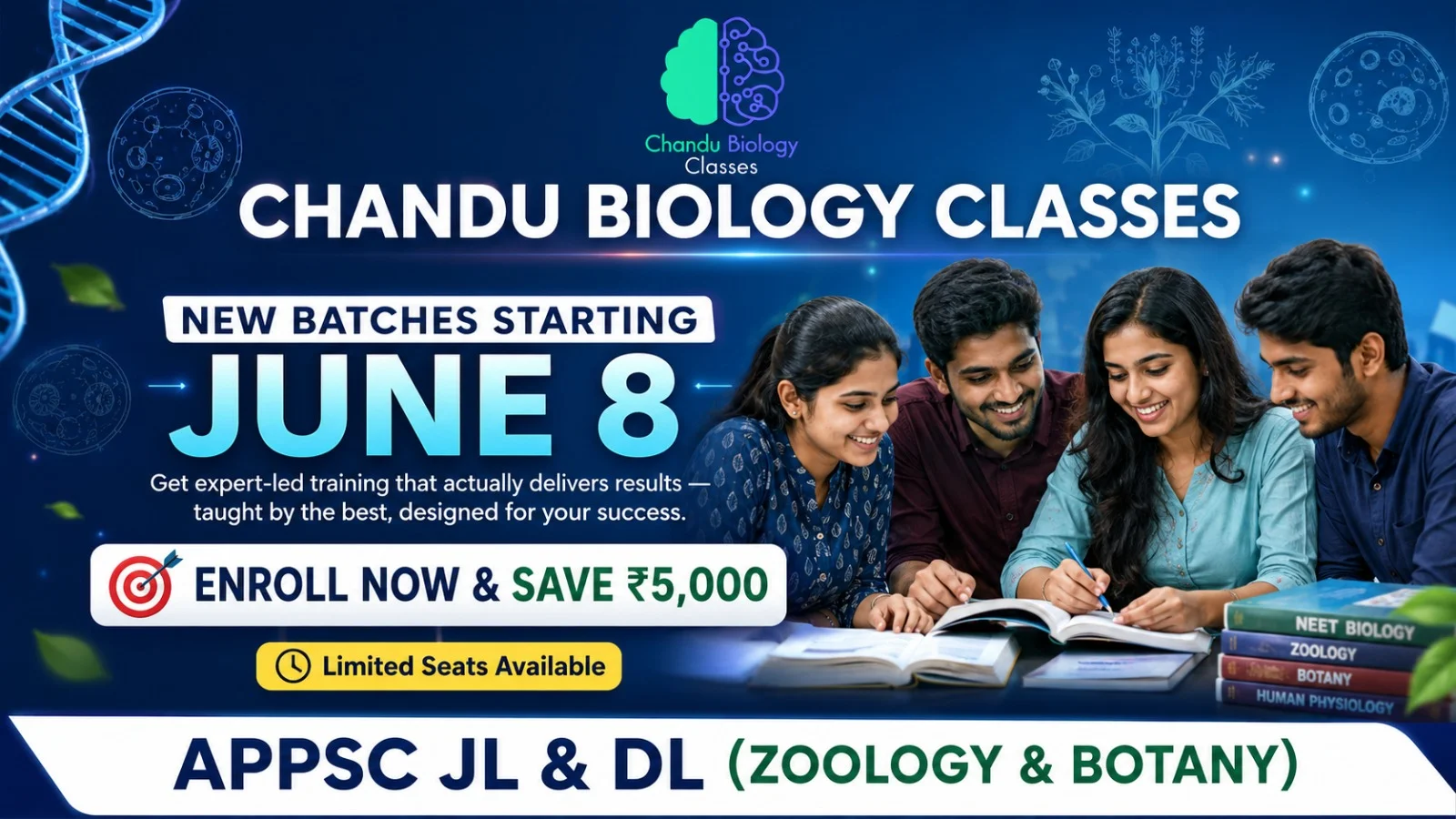
This article gives you everything you need: the complete and detailed APPSC JL Botany syllabus, paper-wise breakdown, exam pattern, vacancy details, eligibility, and how Chandu Biology Classes is helping students across Andhra Pradesh crack this exam with focused, expert-led coaching.
APPSC JL Botany 2024 – Quick Overview
Before diving into the syllabus, here is a snapshot of the key details from Notification No. 17/2023:
| Detail | Information |
|---|---|
| Notification Number | 17/2023 |
| Date of Notification | 30th December 2023 |
| Post | Junior Lecturer in Botany – Government Degree Colleges |
| Post Code | 02 |
| Total Vacancies (Botany) | 20 |
| Scale of Pay | Rs. 57,700 – Rs. 1,82,400 (Academic Level 10, Revised UGC Pay Scale 2016) |
| Age Limit | 18 to 42 years as on 01/07/2023 |
| Exam Mode | Computer Based Test (CBT) – Objective Type |
| Application Period | 24th January 2024 to 13th February 2024 |
Zone-Wise Vacancy Breakdown for APPSC JL Botany
One of the most important things to know before applying is the community-wise and zone-wise distribution of vacancies. Here is the complete breakup for Botany (Post Code 02):
| Category | Zone-I | Zone-II | Zone-III | Zone-IV | Total |
|---|---|---|---|---|---|
| OC | 02 | 03 | 01 | 03 | 09 |
| BC-A | 01 | 01 | – | 01 | 03 |
| SC | 01 | 02 | 01 | 02 | 06 |
| ST | – | 01 | – | 01 | 02 |
| Total | 04 | 07 | 02 | 07 | 20 |
Zone Composition:
- Zone I: Srikakulam, Vizianagaram, Visakhapatnam
- Zone II: East Godavari, West Godavari, Krishna
- Zone III: Guntur, Prakasam, Nellore
- Zone IV: Chittoor, Kadapa, Anantapur, Kurnool
Additionally, horizontal reservations of 33⅓% for Women, 2% for Meritorious Sports Persons, and 4% for Persons with Benchmark Disabilities apply across all categories as per G.O. Ms. No. 77, G.A. (Ser-D) Dept., dated 02.08.2023.
Educational Qualification for APPSC JL Botany
To be eligible for the post of Junior Lecturer in Botany, candidates must fulfill the following:
- Master’s Degree in Botany from a recognized university with at least 55% marks (Grade B in 7-point scale) — relaxable to 50% for SC/ST candidates and Ph.D. holders who passed their Master’s before 19.09.1991.
- NET/SLET qualification — passing the National Eligibility Test conducted by UGC, CSIR, or SLET conducted by the concerned university is compulsory.
- Ph.D. exemption — candidates who have been awarded a Ph.D. degree in compliance with UGC (Minimum Standards and Procedure for Award of Ph.D. Degree) Regulations, 2009 are exempted from NET/SLET.
APPSC JL Botany Exam Pattern 2024
The written examination is objective type and conducted through Computer Based Test (CBT). The scheme is as follows:
| Paper | Subject | No. of Questions | Duration | Maximum Marks |
|---|---|---|---|---|
| Paper 1 | General Studies & Mental Ability (Degree Standard) | 150 | 150 Minutes | 150 |
| Paper 2 | Botany (PG Standard) | 150 | 150 Minutes | 300 |
| Total | 300 | 450 |
Important Points:
- There is negative marking — for each wrong answer, 1/3rd of the marks allotted to that question will be deducted.
- After the written test, shortlisted candidates appear for a Computer Proficiency Test (CPT).
- Final selection is based on merit in the written exam followed by CPT.
Minimum qualifying marks:
- OC / EWS / Ex-Servicemen / Sports Persons: 40%
- Backward Classes: 35%
- SC / ST / PBDs: 30%
Complete APPSC JL Botany Syllabus 2024 – Paper 2
This is the most critical section of this article. Paper 2 is at PG standard, meaning every topic demands depth equivalent to a Master’s level understanding. Here is the complete, official syllabus broken down topic by topic:
Unit 1: Cell and Molecular Biology of Plants
This unit is the foundation of modern botany and carries significant weightage in the APPSC JL exam:
- Cell Wall: Structure, functions, biogenesis, and growth
- Plasma Membrane: Structure, models, functions; ATPases, ion carriers, channels, pumps, and receptors
- Plasmodesmata: Structure, movement of molecules and macromolecules, comparison with gap junctions
- Chloroplast: Structure, genome organization, gene expression, RNA editing, nucleo-chloroplastic interactions
- Mitochondria: Structure, genome organization, biogenesis
- Plant Vacuoles: Tonoplast membrane, ATPases, transporters, storage functions
- Nucleus: Structure, nuclear pores, nucleosome organization, DNA structure (A, B and Z forms), replication, damage and repair, transcription, plant promoters and transcription factors, splicing, mRNA transport, rRNA biosynthesis
- Ribosomes: Structure, protein synthesis mechanism, initiation, elongation, termination; structure and role of tRNA
- Protein Sorting: Targeting of proteins to organelles
- Cell Shape and Motility: Cytoskeleton; microtubules and microfilaments; motor movements; flagellar and other movements
- Cell Cycle and Apoptosis: Control mechanisms; role of cyclins and CDKs; retinoblastoma and E2F proteins; cytokinesis and cell plate formation; programmed cell death
- Other Organelles: Microbodies, Golgi apparatus, lysosomes, endoplasmic reticulum
- Techniques in Cell Biology: Immunotechniques; in situ hybridization; FISH, GISH; confocal microscopy
Unit 2: Cytology, Genetics and Cytogenetics
This unit is a high-scoring section if prepared thoroughly:
- Chromatin Organization: Chromosome structure, packaging of DNA, centromere and telomere molecular organization; euchromatin and heterochromatin; karyotype analysis; banding patterns; polytene, lampbrush, B-chromosomes and sex chromosomes; molecular basis of chromosome pairing
- Structural and Numerical Alterations: Duplication, deficiency, inversion, translocation; autopolyploids; allopolyploids; evolution of major crop plants
- Genetics of Prokaryotes and Eukaryotic Organelles: Genetic recombination in phage; transformation, conjugation and transduction in bacteria; genetics of mitochondria and chloroplasts; cytoplasmic male sterility
- Gene Structure and Expression: Genetic fine structure; cis-trans test; Benzer’s experiment; introns; RNA splicing; regulation of gene expression in prokaryotes and eukaryotes
- Genetic Recombination and Mapping: Independent assortment and crossing over; molecular mechanism of recombination; RecA and RecBCD enzymes; site-specific recombination; chromosome mapping, linkage groups, genetic markers, molecular maps
- Mutations: Spontaneous and induced mutations; physical and chemical mutagens; molecular basis; transposable elements; site-directed mutagenesis; DNA damage and repair
- Plant Breeding: Principles and methods; marker-assisted breeding
- Biostatistics: Mean, Variance, Standard deviation, Standard error, t-test, Chi-square, ANOVA
- Molecular Cytogenetics: Nuclear DNA content; C-value paradox; cot curve; restriction mapping; multigene families
Unit 3: Biology and Diversity of Lower Plants (Cryptogams)
This unit covers the breadth of plant diversity — a favorite for examiners:
- Microbiological Techniques: Pure culture, enrichment and anaerobic culture
- Phycology: Thallus organization; cell ultrastructure; reproduction (vegetative, sexual, asexual); classification criteria (pigments, reserve food, flagella); salient features of Chlorophyta, Charophyta, Xanthophyta, Bacillariophyta, Phaeophyta and Rhodophyta; algal blooms, biofertilizers, food and industrial uses
- Mycology: General characters; cell ultrastructure; unicellular and multicellular organization; cell wall composition; nutrition; reproduction; heterothallism; heterokaryosis; parasexuality; Mastigomycotina, Zygomycotina, Ascomycotina, Basidiomycotina, Deuteromycotina; fungi in industry, medicine and food; fungal diseases; Mycorrhizae; biocontrol agents
- Bryophyta: Morphology, structure, reproduction, life history; Marchantiales, Jungermanniales, Anthocerotales, Sphagnales, Funariales and Polytrichales; economic and ecological importance
- Pteridophyta: Morphology, anatomy and reproduction; evolution of stele; heterospory and seed habit; fossil pteridophytes; Psilopsida, Lycopsida, Sphenopsida and Pteropsida
Unit 4: Taxonomy and Diversity of Seed Plants
- Gymnosperms: Introduction and classification; Cycadales, Ginkgoales, Coniferales, Ephedrales, Welwitschiales and Gnetales
- Species Concept: Taxonomic hierarchy; species, genus, family; principles of relationship; delimitation of taxa
- International Code of Botanical Nomenclature: Salient features
- Taxonomic Tools: Herbarium; floras; histological, cytological, phytochemical, serological, biochemical and molecular techniques; computers and GIS
- Angiosperm Classification Systems: Phenetic vs phylogenetic systems; cladistics; relative merits of major classification systems
- Phytogeography: Endemism, hotspots; plant explorations; invasions and introductions
Unit 5: Plant Physiology and Metabolism
This is one of the most heavily tested units in APPSC JL Botany Paper 2:
- Energy Flow: Thermodynamics, free energy, redox reactions, ATP structure and functions
- Enzymology: Allosteric mechanism, regulatory and active sites, isoenzymes, Michaelis-Menten equation
- Membrane Transport: Plant water relations; mechanism of water transport through xylem; passive and active solute transport; membrane transport proteins
- Signal Transduction: Receptors, G-proteins, phospholipid signaling, cyclic nucleotides, calcium-calmodulin cascade, protein kinases and phosphatases
- Photosynthesis: Photosynthetic pigments; light harvesting complexes; photoxidation of water; electron and proton transport; Calvin cycle; photorespiration; C4 cycle; CAM pathway; starch and sucrose biosynthesis
- Respiration and Lipid Metabolism: Glycolysis; TCA cycle; electron transport; ATP synthesis; pentose phosphate pathway; glyoxylate cycle; fatty acid biosynthesis; membrane, structural and storage lipids
- Nitrogen Fixation and Metabolism: Biological nitrogen fixation; nodule formation; nod factors; nitrate uptake and reduction; ammonium assimilation
- Photobiology: Phytochromes and cryptochromes; photophysiology of light-induced responses
- Plant Growth Regulators: Physiological effects and mechanism of action of auxins, gibberellins, cytokinins, ethylene, ABA, brassinosteroids, polyamines, jasmonic acid and salicylic acid
- Flowering Process: Photoperiodism; endogenous clock; floral induction; vernalization
- Stress Physiology: Biotic and abiotic stress; HR and SAR; water deficit; salinity; metal toxicity; freezing; heat stress; oxidative stress; IPM
Unit 6: Plant Development and Reproduction
- Shoot Development: SAM organization; cell division and cell-to-cell communication; xylem and phloem differentiation; secretory ducts and laticifers; phyllotaxy and leaf differentiation
- Root Development: RAM organization; cell fates and lineages; vascular tissue differentiation; homeotic mutants in Arabidopsis and Antirrhinum; sex determination
- Male Gametophyte: Anther structure; microsporogenesis; role of tapetum; pollen development; male sterility; pollen germination, tube growth and guidance; pollen storage; pollen allergy; pollen embryos
- Female Gametophyte: Ovule development; megasporogenesis; embryo sac organization
- Pollination and Fertilization: Floral characteristics; pollination mechanisms; self-incompatibility; double fertilization
- Seed Development and Fruit Growth: Endosperm development; embryogenesis; storage proteins; polyembryony; apomixis; embryo culture; fruit maturation
- Dormancy: Seed dormancy; overcoming dormancy; bud dormancy
- Senescence and PCD: Types of cell death; PCD in plant life cycle; metabolic changes; hormonal and environmental factors on senescence
Unit 7: Plant Ecology
- Climate, Soil and Vegetation Patterns: Life zones; major biomes; vegetation and soil types
- Vegetation Organization: Community and continuum concepts; analytical and synthetic characters
- Ecological Succession: Hydrosere and xerosere
- Ecosystem Organization: Primary production (methods, global patterns, controlling factors); energy dynamics (trophic organization, energy flow pathways, ecological efficiencies); litter fall and decomposition; global biogeochemical cycles (C, N, P, S)
- Biological Diversity: Concept and levels; biodiversity in ecosystem functions; speciation and extinction; IUCN categories; distribution and global patterns; terrestrial biodiversity hotspots
- Air, Water and Soil Pollution: Kinds, sources, quality parameters; effects on plants and ecosystems
- Climate Change: Greenhouse gases (CO2, CH4, N2O, CFCs); ozone layer and ozone hole; consequences (CO2 fertilization, global warming, sea level rise, UV radiation)
- Ecosystem Stability: Resistance and resilience; ecological perturbations; plant invasion ecology; environmental impact assessment; ecosystem restoration
Unit 8: Plant Resource Utilization and Conservation
- Plant Biodiversity and Sustainable Development
- Origin, Evolution, Botany, Cultivation and Uses of: food, forage and fodder crops; fibre crops; medicinal and aromatic plants; vegetable oil-yielding crops; ethnobotany
- Forest Products: Important firewood and timber-yielding plants; bamboos, rattans, paper raw materials, gums, tannins, dyes, resins and fruits
- Green Revolution: Benefits and adverse consequences
- Conservation Principles: Extinctions; environmental status of plants (IUCN)
- In Situ Conservation: International efforts and Indian initiatives; protected areas (sanctuaries, national parks, biosphere reserves, wetlands, mangroves, coral reefs)
- Ex Situ Conservation: Botanical gardens, field gene banks, seed banks, in vitro repositories, cryobanks; BSI, NBPGR, ICAR, CSIR, DBT activities
Unit 9: Biotechnology and Genetic Engineering of Plants and Microbes
This unit bridges modern science with botany and has become increasingly important in recent exams:
- Plant Biotechnology: Principles, scope and applications
- Plant Cell and Tissue Culture: Totipotency; cellular differentiation; organogenesis; adventive embryogenesis; morphogenesis; somatic embryogenesis
- Somatic Hybridization: Protoplast isolation, fusion and culture
- Applications of Plant Tissue Culture: Clonal propagation; artificial seeds; production of hybrids and somaclones; secondary metabolites and natural products; cryopreservation and germplasm storage
- Recombinant DNA Technology: Gene cloning; genomic and cDNA libraries; vectors; DNA synthesis and sequencing; PCR; DNA fingerprinting and markers
- Genetic Engineering of Plants: Transgenic plants; Agrobacterium-mediated and microprojectile gene transfer; chloroplast transformation; intellectual property rights; ecological risks and ethical concerns
- Microbial Genetic Manipulation: Bacterial transformation; selection of recombinants; improvement of industrial microbes
- Genomics and Proteomics: High-throughput sequencing; genome projects; bioinformatics; functional genomics; microarrays
Paper 1: General Studies & Mental Ability – Key Topics
While most candidates focus on Paper 2, Paper 1 (150 marks) should never be neglected. Key areas include:
- Current Events – International, National and Andhra Pradesh
- General Science and its applications; developments in Science, Technology and IT
- History of India with focus on AP and Indian National Movement
- Geography of India with focus on Andhra Pradesh
- Indian Polity, Governance and e-Governance
- Indian Economy and Planning
- Sustainable Development and Environmental Protection
- Disaster Management
- Logical Reasoning and Analytical Ability
- Data Analysis – tabulation, visual representation, summary statistics
How Chandu Biology Classes Is Powering APPSC JL Botany Aspirants
If you are serious about clearing APPSC JL Botany, then preparation quality matters as much as effort. That is where Chandu Biology Classes comes in.
Chandu Biology Classes has built a strong reputation among APPSC JL Life Sciences aspirants across Andhra Pradesh. The institute specializes in coaching for GATE Life Sciences, APPSC JL Botany, APPSC JL Zoology, and related exams — with a faculty team that brings deep subject expertise and an understanding of exactly what the APPSC examination demands.
Why Students Choose Chandu Biology Classes:
Subject Depth at PG Level The APPSC JL Botany Paper 2 is at PG standard, which means you cannot prepare from undergraduate notes alone. Chandu Biology Classes delivers coaching at the right academic depth, covering every topic of the official syllabus from cell biology and molecular genetics to plant ecology and biotechnology.
Systematic Syllabus Coverage Rather than random topic-by-topic teaching, the institute follows a structured schedule that ensures complete syllabus coverage well before the exam date — giving students adequate time for revision and mock tests.
Exam-Focused Teaching Style Faculty at Chandu Biology Classes are trained to teach not just concepts but also the type of questions that appear in APPSC JL exams. This includes multiple-choice questions at PG level, trick questions, and application-based problems.
Study Material Students receive comprehensive, exam-ready study material prepared specifically for the APPSC JL Botany syllabus — saving hours of research and ensuring no important topic is missed.
Both Online and Offline Options Recognizing that students come from different parts of Andhra Pradesh and different life situations, Chandu Biology Classes offers flexible learning modes:
- Online Classes: Rs. 25,000
- Offline Classes: Rs. 30,000
This makes professional coaching accessible regardless of where you live in the state.
Subject-Wise Preparation Strategy for APPSC JL Botany Paper 2
Here is a topic priority guide based on the syllabus:
High Weightage Topics (Must-Master):
- Plant Physiology and Metabolism (especially photosynthesis, respiration, plant hormones)
- Cell and Molecular Biology
- Genetics and Cytogenetics
- Plant Biotechnology and Genetic Engineering
Moderate Weightage Topics (Study Thoroughly):
- Taxonomy and Diversity of Seed Plants
- Plant Ecology
- Cryptogams (Algae, Fungi, Bryophytes, Pteridophytes)
- Plant Development and Reproduction
Supporting Topics (Do Not Skip):
- Plant Resource Utilization and Conservation
- Biostatistics (appears across multiple units — learn it once, apply everywhere)
Frequently Asked Questions (FAQs) – APPSC JL Botany
Q1. How many vacancies are there for APPSC JL Botany in 2024? As per Notification No. 17/2023, there are 20 vacancies for the post of Junior Lecturer in Botany across all four zones of Andhra Pradesh.
Q2. Is NET compulsory for APPSC JL Botany? Yes, NET/SLET is compulsory for APPSC JL Botany. However, candidates who hold a Ph.D. degree awarded in compliance with UGC Regulations 2009 are exempted from this requirement.
Q3. What is the salary for APPSC Junior Lecturer Botany? The pay scale is Rs. 57,700 – Rs. 1,82,400 under Academic Level 10 as per the Revised UGC Pay Scale, 2016.
Q4. What is the age limit for APPSC JL Botany? The age limit is 18 to 42 years as on 01/07/2023. Relaxations are available for SC/ST/BC (5 years), PBD (10 years), and other categories as per rules.
Q5. What is the exam pattern for APPSC JL Botany? The exam consists of two papers: Paper 1 (General Studies & Mental Ability, 150 questions, 150 marks) and Paper 2 (Botany at PG standard, 150 questions, 300 marks). Both are objective-type CBT exams with negative marking of 1/3rd for each wrong answer.
Q6. Is there a Computer Proficiency Test (CPT) for APPSC JL Botany? Yes. After the written examination, shortlisted candidates must appear for a Computer Proficiency Test (CPT). Final selection is based on merit in the written exam followed by CPT.
Q7. What is the fee for Chandu Biology Classes APPSC JL Botany coaching? The coaching fee at Chandu Biology Classes is Rs. 25,000 for online classes and Rs. 30,000 for offline classes.
Q8. Which topics carry the most marks in APPSC JL Botany Paper 2? Plant Physiology and Metabolism, Cell and Molecular Biology, Genetics and Cytogenetics, and Plant Biotechnology are considered the most important topics based on the syllabus depth and previous exam patterns.
Q9. Can I prepare for APPSC JL Botany along with GATE Life Sciences simultaneously? Yes, and this is actually one of the smartest strategies. Both exams share significant syllabus overlap — particularly in Cell Biology, Genetics, Plant Physiology and Ecology. Chandu Biology Classes specifically caters to students preparing for both simultaneously.
Q10. Is local reservation applicable for APPSC JL posts? No. As per the notification, local reservation is not applicable. Selection is made on state-wide merit, and zone allotment is done based on candidate preference.
Q11. How many times has APPSC conducted JL Botany recruitment? APPSC conducts Junior Lecturer recruitment periodically based on vacancies reported by the Commissioner of Collegiate Education. Candidates should regularly visit psc.ap.gov.in for the latest notifications.
Q12. Does Chandu Biology Classes provide study material for APPSC JL Botany? Yes. Chandu Biology Classes provides dedicated study material aligned with the official APPSC JL Botany syllabus, covering all nine major units of Paper 2 along with General Studies preparation for Paper 1.
Conclusion: Take the Right Step Toward Your Government Lecturer Career
The APPSC Junior Lecturer Botany recruitment is a rare and valuable opportunity. With 20 vacancies, a highly competitive applicant pool, and a PG-standard Paper 2, your preparation approach can be the single biggest factor that separates you from the rest.
Start with a complete understanding of the syllabus — and you have just done that by reading this article. The next step is structured, expert-guided preparation.
Chandu Biology Classes is already helping students across Andhra Pradesh move from aspiration to selection. With affordable fee structures — Rs. 25,000 for online and Rs. 30,000 for offline — professional coaching for APPSC JL Botany has never been more accessible.
Whether you are a fresh PG graduate or someone who has been appearing for government exams for a while, the right coaching can make all the difference. Join Chandu Biology Classes today and give your APPSC JL Botany preparation the direction it deserves.
Disclaimer: The information provided in this article, including syllabus details, vacancy figures, eligibility criteria, and examination patterns, has been compiled from publicly available sources on the internet, primarily based on APPSC Notification No. 17/2023. While every effort has been made to ensure accuracy, readers are advised to verify all details directly from the official APPSC website (psc.ap.gov.in) before making any decisions. Chandu Biology Classes bears no responsibility for any discrepancies arising from changes in official notifications after the publication of this article.
