
Every year, thousands of biology graduates in Andhra Pradesh sit for the APPSC Degree Lecturer (DL) Zoology examination, and every year a majority of them fall short — not because they lack knowledge, but because they lack direction. The difference between candidates who clear the exam and those who don’t almost always comes down to one thing: structured preparation within a defined timeline.
If you have 60 days ahead of you and you’re wondering whether it’s enough to crack APPSC DL Zoology, the answer is yes — absolutely — provided you follow the right approach. Sixty days, when used efficiently, gives you ample time to cover the complete syllabus, revise critical topics multiple times, practice previous papers, and walk into the exam hall with real confidence.
This guide is built specifically for that 60-day window. Whether you’re a fresh postgraduate, a working professional preparing alongside a job, or someone retaking the exam with a determined mindset, this roadmap will give you everything you need. It also gives you an honest look at how professional coaching — especially from institutions like Chandu Biology Classes — can accelerate your preparation dramatically.
Let’s begin.
Understanding the APPSC DL Zoology Exam: Pattern and Syllabus Overview
Before you plan your 60 days, you need to know exactly what you’re preparing for. The APPSC Degree Lecturer Zoology paper tests candidates on both subject-specific knowledge and general aptitude. Here’s what the exam broadly covers:
Paper I – General Studies and Mental Ability This paper tests reasoning, current affairs, and general knowledge. Many candidates underestimate this paper and lose crucial marks here.
Paper II – Zoology Subject Paper This is the core paper. It covers:
- Cell Biology and Genetics
- Molecular Biology and Biotechnology
- Animal Physiology
- Developmental Biology (Embryology)
- Ecology and Environmental Biology
- Evolution and Systematics
- Diversity of Animal Life (Non-chordata and Chordata)
- Economic Zoology and Applied Aspects
- Parasitology and Immunology
The depth at which each topic is tested is at the postgraduate level. This is why random reading won’t work. You need focused, topic-by-topic, structured preparation — and 60 days is precisely the right span for that if you’re disciplined.
The 60-Day Master Plan: Week-by-Week Breakdown
This is the core of your strategy for how to crack APPSC DL Zoology in 60 days. Do not skip or rearrange the weeks randomly — each phase builds on the previous one.
Week 1–2: Foundation and High-Weightage Topics
The first two weeks should be used to lay a rock-solid foundation. Start with the topics that carry maximum marks and appear consistently in previous question papers.
Focus Areas:
- Cell Biology: Cell cycle, mitosis, meiosis, cell organelles, membrane structure
- Genetics: Mendelian genetics, linkage and crossing over, mutation, chromosomal theory
- Molecular Biology: DNA structure, replication, transcription, translation, gene regulation
Daily target: 6–8 hours of study, 2 topics per day, 15–20 APPSC-style questions in the evening.
Why start here? Because these topics interconnect with almost everything else in the paper. If your cell biology and genetics are solid, your understanding of immunology, developmental biology, and even ecology becomes significantly easier.
Week 3–4: Physiology, Embryology, and Diversity
Focus Areas:
- Animal Physiology: Digestion, respiration, circulation, excretion, nervous system, endocrinology, reproduction
- Developmental Biology: Gametogenesis, fertilization, cleavage, gastrulation, organogenesis, metamorphosis
- Diversity of Animal Life: Major phyla from Porifera to Mammalia — characteristics, classification, representative examples
This two-week block is often where candidates either pull ahead or fall behind. Physiology is vast but highly predictable — the same 20–25 key mechanisms appear in APPSC DL Zoology papers repeatedly. Similarly, animal diversity questions follow a consistent pattern around taxonomic characters and evolutionary significance.
Tip: Don’t try to memorize every species. Instead, understand the defining characters of each phylum/class and the evolutionary transitions between groups.
Week 5: Ecology, Evolution, and Environmental Biology
Focus Areas:
- Ecology: Population ecology, community ecology, ecosystem structure and function, energy flow, biogeochemical cycles
- Evolution: Theories of evolution, natural selection, speciation, molecular evolution, Hardy-Weinberg principle
- Environmental Biology: Pollution, conservation, wildlife management, biodiversity hotspots
These topics are increasingly important in APPSC DL Zoology because the state has shown a consistent interest in ecology and environmental questions, especially related to Andhra Pradesh’s biodiversity and conservation priorities.
Tip: Link ecology with current environmental news. APPSC occasionally frames questions around real-world ecological events in India.
Week 6: Applied Zoology, Parasitology, and Immunology
Focus Areas:
- Economic Zoology: Sericulture, apiculture, pisciculture, lac culture, pearl culture
- Parasitology: Life cycles of Plasmodium, Ascaris, Taenia, Leishmania, Entamoeba
- Immunology: Innate and adaptive immunity, antibody structure and classes, antigen-antibody reactions, vaccines, hypersensitivity
These are “scoring topics” — candidates who master them tend to perform significantly better in the final exam. Applied Zoology in particular has direct questions that are straightforward to answer if prepared correctly.
Week 7: Revision, Mock Tests, and Previous Year Papers
This is your consolidation phase. During week 7:
- Go through your notes from weeks 1–6
- Solve at least 5 full-length mock tests under timed conditions
- Analyze your performance topic-by-topic — wherever you score below 60%, revise that topic immediately
- Focus on APPSC DL Zoology previous question papers from the last 5–10 years
There is no better practice than past papers. APPSC has patterns — topic priorities don’t shift dramatically year to year, and you’ll notice recurring question types once you solve enough papers.
Week 8: Final Revision and Exam Readiness
The last week is for consolidating, not learning new content. Absolutely avoid picking up new topics at this stage.
- Revise your short notes and keyword lists
- Focus on weak areas identified in mock tests
- Maintain your sleep schedule and physical health
- On the final two days, just review high-yield one-liners and relax
Daily Study Schedule That Actually Works
Many candidates plan in theory but fail in practice because they don’t have a realistic daily structure. Here’s a schedule that balances intensity with sustainability for a 60-day effort:
6:00 AM – 8:00 AM: Morning session — New topic study (fresh mind, best for conceptual learning)
8:00 AM – 9:00 AM: Breakfast and light review of yesterday’s notes
9:00 AM – 12:00 PM: Deep study session — Detailed reading, diagrams, note-making
12:00 PM – 1:00 PM: Lunch and rest
1:00 PM – 3:00 PM: Practice session — APPSC-style MCQs related to the morning topic
3:00 PM – 5:00 PM: General Studies (Paper I) preparation
5:00 PM – 5:30 PM: Break
5:30 PM – 8:00 PM: Evening study — Revision of previous topics, previous year paper practice
8:00 PM – 9:00 PM: Light reading — ecology, current affairs, environmental news
9:00 PM onwards: Rest, sleep by 10:30 PM
This schedule gives you approximately 10–11 productive hours per day, which over 60 days totals 600+ hours of preparation — more than enough to cover the APPSC DL Zoology syllabus thoroughly.
Most Important Topics to Prioritize for APPSC DL Zoology
Based on analysis of previous APPSC DL Zoology papers, here are the topics you absolutely cannot afford to skip:
Very High Priority (appear in almost every paper):
- Cell cycle and division (Mitosis, Meiosis)
- Mendelian genetics and gene interaction
- DNA structure, replication, and repair mechanisms
- Protein synthesis (transcription and translation)
- Hormone mechanisms and endocrine glands
- Life cycles of major parasites (Plasmodium, Taenia, Ascaris)
- Ecological pyramids and food webs
- Hardy-Weinberg law and speciation theories
High Priority:
- Embryonic development — cleavage, gastrulation, fate maps
- Antibody structure, types, and antigen-antibody reactions
- Excretory organs and osmoregulation across animal groups
- Comparative anatomy and evolutionary significance of organ systems
- Applied Zoology — sericulture, apiculture, pisciculture
Moderate Priority (but don’t skip):
- Animal behavior (ethology — Pavlov, Lorenz, Tinbergen)
- Recombinant DNA technology and CRISPR
- Biodiversity measurement and conservation strategies
- Biogeochemical cycles (Carbon, Nitrogen, Phosphorus)
Why You Should Consider Coaching for APPSC DL Zoology
Self-study is powerful, but the reality is that APPSC DL Zoology is a highly competitive exam with hundreds of qualified postgraduates competing for a limited number of positions. In such a scenario, structured coaching can give you the edge that separates rank-holders from the rest.
Good coaching provides:
- A pre-sorted, exam-focused syllabus so you don’t waste time on low-priority content
- Expert faculty who know what APPSC actually tests versus what textbooks say
- Regular mock tests benchmarked against real exam difficulty
- Personal guidance on weak areas
- A peer group that keeps you motivated and accountable
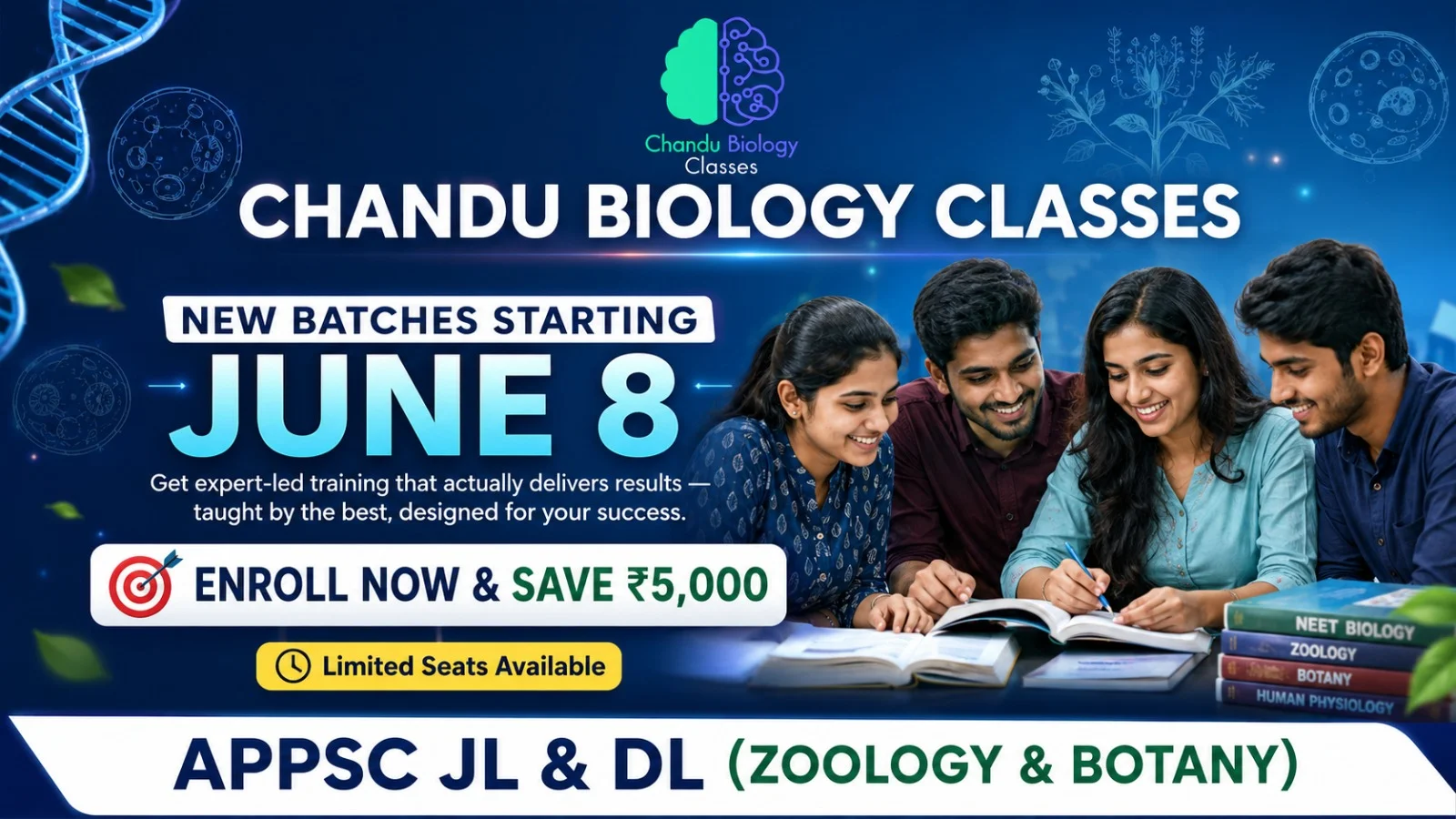
One name that consistently comes up among serious APPSC DL Biology aspirants in Andhra Pradesh is Chandu Biology Classes.
Chandu Biology Classes: Coaching Built for APPSC DL Zoology Aspirants
Chandu Biology Classes has earned a strong reputation among Biology and Zoology aspirants preparing for state-level competitive exams in Andhra Pradesh, including the APPSC DL examination. The institute is known for its focused, exam-oriented curriculum and faculty who understand the specific demands of APPSC-pattern questions.
What makes Chandu Biology Classes a preferred choice for many aspirants is the clarity and depth with which complex topics — from molecular genetics to developmental biology — are taught in a way that directly connects to APPSC exam requirements.
Fee Structure at Chandu Biology Classes
For aspirants considering joining, here is the current fee structure:
- Online Coaching: ₹25,000
- Offline Coaching (Classroom): ₹30,000
The online mode offers flexibility for candidates who are working or based outside the coaching center’s location, while the offline classroom mode provides the benefits of direct faculty interaction and a structured study environment.
If you are seriously preparing to crack APPSC DL Zoology in 60 days or planning a longer, more comprehensive preparation cycle, enrolling in Chandu Biology Classes can be a strategic investment in your exam success.
Common Mistakes That Derail APPSC DL Zoology Preparation
Even well-prepared candidates make avoidable mistakes. Here are the most common pitfalls and how to avoid them:
1. Reading textbooks cover-to-cover instead of strategically APPSC doesn’t test textbook completeness — it tests specific concepts. Read selectively based on previous paper analysis.
2. Neglecting Paper I (General Studies) Many biology candidates focus entirely on subject paper and underperform in General Studies, which can cost them the rank. Allocate at least 2 hours daily to Paper I from Day 1.
3. Not solving previous year papers Previous papers are the most authentic guide to APPSC’s question style, difficulty, and topic preferences. Candidates who skip this step are preparing blindly.
4. Leaving revision to the last minute Revision cannot be compressed into three days. It needs to be built into your weekly routine from Week 1 onwards.
5. Ignoring applied and economic zoology This section is often underestimated. It has direct, factual questions that are easy marks for prepared candidates — don’t leave them on the table.
6. Poor time management during the exam Practice solving 100-question papers within the actual exam time limit. Speed and accuracy both matter.
Books and Resources Recommended for APPSC DL Zoology
While coaching can provide structured content, having the right reference books strengthens your understanding:
Cell Biology and Genetics:
- Cell and Molecular Biology — De Robertis and De Robertis
- Genetics — Strickberger (select chapters)
Animal Physiology:
- A Textbook of Animal Physiology — C.K. Bhatt
Developmental Biology:
- Developmental Biology — Gilbert (select chapters on vertebrate development)
Ecology:
- Ecology — Odum (fundamental concepts)
Diversity of Animals:
- Invertebrate Zoology — Jordan and Verma
- Chordate Zoology — Jordan and Verma
For MCQ practice:
- Previous year APPSC DL Zoology question papers (2015–2024)
- APPSC-specific biology MCQ books available at local academic bookstores in Andhra Pradesh
How to Approach APPSC DL Zoology Paper During the Exam
Knowing the content is one thing. Performing optimally on exam day is another. Here’s how to approach the paper strategically:
Start with your strongest topic section. This builds momentum and confidence early in the exam.
Don’t get stuck on difficult questions. Mark them, move on, and return if time allows. Every question carries equal marks, so a difficult question you spend 3 minutes on isn’t worth more than an easy one you answer in 30 seconds.
Manage time actively. With approximately 150–200 questions in a limited time window, you should maintain a pace of roughly 45–60 seconds per question on average.
Read options carefully. APPSC questions often have very similar-sounding options. Read all four options before marking your answer.
Don’t leave blanks if there’s no negative marking. Always attempt every question. If negative marking applies, skip only if you’re genuinely unsure after eliminating at least two options.
Staying Motivated Through 60 Days of Intense Preparation
A 60-day sprint is mentally demanding. Here’s how to maintain your momentum:
Break the goal into weekly milestones. Instead of thinking about 60 days, think about this week’s syllabus target. Small wins keep motivation alive.
Track your progress visibly. Keep a physical checklist of topics covered. Seeing it fill up is genuinely motivating.
Find your study community. Whether it’s a coaching batch at Chandu Biology Classes or an online group of APPSC aspirants, studying alongside others creates accountability.
Celebrate small victories. Scored 80% on a mock test? That’s worth acknowledging. Finished the embryology unit ahead of schedule? Great — reward yourself with something small.
Remember your why. Write down why you’re preparing for this exam — financial stability, serving through education, professional pride — and put it somewhere visible. On tough days, it helps.
Frequently Asked Questions (FAQs): What APPSC DL Zoology Aspirants Are Searching For
Q1. Can I crack APPSC DL Zoology in 60 days without coaching?
Yes, it’s possible, but it requires extreme discipline and the right study material. Having a structured plan like the one in this article helps significantly. That said, coaching — especially from focused institutes like Chandu Biology Classes — reduces wasted effort and provides exam-specific guidance that self-study alone may miss.
Q2. What is the syllabus for APPSC DL Zoology?
The APPSC DL Zoology syllabus covers Cell Biology, Genetics, Molecular Biology, Animal Physiology, Developmental Biology, Ecology, Evolution, Diversity of Animal Life, Economic Zoology, Parasitology, and Immunology — tested at the postgraduate level. Always download the official, updated syllabus from the APPSC official website before beginning preparation.
Q3. How many questions are asked in APPSC DL Zoology?
The exact number of questions varies with each notification, but Paper II (Zoology subject paper) typically contains 150 questions. Always verify the exam pattern from the official APPSC notification for your exam cycle.
Q4. Is APPSC DL Zoology exam tough compared to other biology exams?
It is moderately to highly competitive because the candidate pool consists of postgraduates with strong academic backgrounds. The difficulty level is postgraduate standard, and the competition for limited DL positions is significant. Structured preparation and previous paper practice are essential.
Q5. What are the best books for APPSC DL Zoology preparation?
Recommended books include De Robertis for Cell Biology, Strickberger for Genetics, Jordan and Verma for Zoology diversity topics, Odum for Ecology, and Gilbert’s Developmental Biology for embryology. Supplementing these with previous year APPSC papers is essential.
Q6. Does Chandu Biology Classes provide online coaching for APPSC DL Zoology?
Yes. Chandu Biology Classes offers both online and offline coaching. Online coaching is available at ₹25,000 and offline classroom coaching is available at ₹30,000. The institute is specifically known for its Zoology and Biology exam preparation for state-level competitive exams including APPSC DL.
Q7. What is the salary of an APPSC Degree Lecturer?
The pay scale for a Degree Lecturer (DL) in Andhra Pradesh follows AP government Pay Revision Orders. The gross monthly salary, including allowances, is generally attractive and comparable to other government lecturer posts in the state. Refer to the official APPSC notification for exact pay details.
Q8. How many times can I attempt the APPSC DL Zoology exam?
APPSC generally doesn’t impose an attempt limit for Degree Lecturer positions, but age limit restrictions apply. Always check the eligibility criteria in the current official notification for age relaxation details applicable to your category.
Q9. Is there negative marking in APPSC DL Zoology?
Negative marking rules vary with each APPSC notification. In some exam cycles, there is no negative marking; in others, there is a deduction per wrong answer. Always refer to the official notification for your exam before deciding whether to attempt uncertain questions.
Q10. How to crack APPSC DL Zoology in 60 days if I’m working a job?
It is challenging but not impossible. Adjust the daily schedule to fit your available hours — typically early mornings, lunch breaks, and evenings. Prioritize the highest-weightage topics first, rely heavily on concise notes and MCQ practice, and consider online coaching from Chandu Biology Classes, which offers flexibility for working professionals.
Final Words: Your 60-Day Opportunity Starts Now
The path to cracking how to crack APPSC DL Zoology in 60 days is not a mystery — it’s a matter of clarity, consistency, and smart effort applied over two focused months. The candidates who succeed aren’t necessarily the most brilliant in the room; they’re the ones who showed up every day, followed a plan, practiced with purpose, and didn’t lose sight of the goal.
You now have the full 60-day blueprint in your hands. You know the priority topics, the weekly structure, the daily schedule, the common mistakes to avoid, and the resources to use. You also know that coaching from Chandu Biology Classes — with online batches at ₹25,000 and offline batches at ₹30,000 — can meaningfully elevate your preparation if you want expert guidance to accelerate your progress.
Start today. Day 1 of 60 is always the most important. Every chapter you cover, every mock test you attempt, and every revision session you complete is a step closer to the rank you’re preparing for.
Your APPSC DL Zoology journey begins now — make it count.
