
If you are preparing for the APPSC Junior Lecturer Botany examination, then you already know how competitive and demanding this recruitment process is. Thousands of candidates appear for this exam every year, and only those who prepare strategically — not just hard — manage to secure a seat. One of the most powerful tools in your preparation arsenal is studying APPSC JL Botany previous year question papers with solutions PDF. These papers are not just a formality; they are the backbone of any serious preparation strategy.
In this comprehensive guide, we will walk you through everything — from why previous year papers matter, to how to use them effectively, to where you can get expert guidance from some of the best coaching available in the country. We will also cover chapter-wise important topics, exam pattern breakdowns, and frequently asked questions that students just like you are searching for right now.
Let’s dive deep.
Why APPSC JL Botany Previous Year Question Papers Are Non-Negotiable
Before we discuss strategy, let’s establish one fundamental truth: the exam does not change drastically year over year. The Andhra Pradesh Public Service Commission follows a relatively consistent pattern when it comes to subject coverage, difficulty level, and the type of questions asked. This means that if you have thoroughly studied APPSC JL Botany previous year question papers with solutions PDF, you are already several steps ahead of candidates who are only reading textbooks.
Here is what previous year papers give you that no textbook can:
1. Real Exam Exposure
You get to experience the actual tone, language, and complexity of questions that APPSC setters prefer. This is different from the theoretical understanding you develop through standard study material.
2. Topic Prioritization
Not every chapter in Botany carries equal weightage in the APPSC JL exam. By analyzing 5 to 10 years of previous papers, you can clearly identify which topics are asked repeatedly — Plant Physiology, Cell Biology, Genetics, Taxonomy, Ecology, Biotechnology — and allocate your study hours accordingly.
3. Time Management Practice
One of the biggest reasons candidates fail competitive exams is poor time management during the actual test. Practicing with previous papers trains your brain to work within time limits.
4. Self-Assessment
Without honest self-assessment, preparation becomes aimless. Solving previous papers and checking your answers against solutions helps you identify weak areas before it’s too late.
5. Confidence Building
There is a psychological benefit too. When you walk into the exam hall having already solved 8 to 10 years of question papers, the unfamiliar becomes familiar. Your anxiety reduces significantly.
Understanding the APPSC Junior Lecturer Botany Exam Pattern
Before you begin solving papers, you need to understand the structure of the examination. The APPSC JL (Junior Lecturer) recruitment is conducted to fill vacancies in Government Junior Colleges across Andhra Pradesh. The selection process generally includes:
Paper Structure
Paper I – General Studies and General Abilities This paper tests your general awareness, reasoning, and aptitude. It is common across all subjects.
Paper II – Botany (Subject Paper) This is the core paper that tests your depth of knowledge in Botany. It is typically objective type (multiple choice questions) and covers the following broad areas:
| Topic Area | Approximate Weightage |
|---|---|
| Plant Morphology and Anatomy | 8–10% |
| Cell Biology and Genetics | 12–15% |
| Plant Physiology and Biochemistry | 12–15% |
| Plant Taxonomy and Systematics | 10–12% |
| Ecology and Environmental Biology | 8–10% |
| Plant Pathology and Microbiology | 8–10% |
| Biotechnology and Molecular Biology | 12–15% |
| Economic Botany and Ethnobotany | 5–8% |
| Embryology and Reproduction | 8–10% |
| Evolution and Paleobotany | 5–7% |
Understanding this distribution is critical when you analyze APPSC JL Botany previous year question papers with solutions PDF because you will see this pattern reflecting consistently across years.
Year-Wise Topic Analysis from Previous Papers
Topics That Appear Almost Every Year
Based on a thorough analysis of previous year papers, the following topics have shown consistent presence:
From Cell Biology and Genetics:
- Mitosis and Meiosis (mechanisms, stages, significance)
- Mendelian Genetics and its exceptions
- DNA replication, transcription, translation
- Chromosomal aberrations
- Linkage and crossing over
From Plant Physiology:
- Photosynthesis — Light reactions, Calvin cycle, C4 and CAM pathways
- Respiration — Glycolysis, Krebs cycle, oxidative phosphorylation
- Mineral nutrition and deficiency symptoms
- Plant hormones and their roles
- Seed germination and dormancy
From Biotechnology:
- Recombinant DNA technology
- PCR and its applications
- Transgenic plants
- Bioreactors
- CRISPR-Cas9 (increasingly asked in recent papers)
From Taxonomy:
- Systems of classification — Bentham and Hooker, Engler and Prantl, Cronquist
- Important families — Fabaceae, Solanaceae, Asteraceae, Poaceae
- ICBN rules and nomenclature
From Ecology:
- Ecosystem structure and function
- Biogeochemical cycles
- Population ecology and dynamics
- Biodiversity and conservation
How to Effectively Use APPSC JL Botany Previous Year Question Papers with Solutions PDF
Simply downloading and reading the papers is not enough. You need a structured approach to extract maximum value from these resources.
Step 1: Organize Papers Year-Wise
Start from the oldest available paper and work your way toward the most recent one. This gives you a sense of how the exam has evolved over the years.
Step 2: Attempt Without Solutions First
Always attempt each paper without looking at the solutions. Treat every practice session as a real exam. Set a timer and maintain exam-like conditions.
Step 3: Analyze Your Performance
After attempting, go through the solutions carefully. Don’t just mark right and wrong. Understand why a particular answer is correct. This conceptual understanding is what will help you in new and twisted questions.
Step 4: Maintain an Error Log
Keep a dedicated notebook where you write down every question you got wrong, along with the correct answer and concept. Revisit this notebook every week.
Step 5: Identify Repetitive Questions
Certain questions, or variations of them, appear in multiple years. Highlight these. They are almost certainly going to appear in some form in your upcoming exam as well.
Step 6: Study the Solutions Conceptually
This is where having access to APPSC JL Botany previous year question papers with solutions PDF with detailed explanations becomes invaluable. The solution is not just the answer — it is the reasoning, the concept, the exception, and the application.
Important Botany Concepts That Frequently Appear in APPSC JL Exams
Let’s go through some of the high-frequency conceptual areas with brief notes that will help you as you work through previous papers:
Plant Taxonomy – Key Points
- Binomial nomenclature was introduced by Carl Linnaeus
- ICBN governs the naming of plants
- Bentham and Hooker’s classification is based on dried herbarium specimens
- APG (Angiosperm Phylogeny Group) system is the most modern molecular-based classification
- Know the floral formulas and diagrams of major families
Genetics – Key Points
- Incomplete dominance vs codominance — understand the difference clearly
- Multiple alleles, polygenic inheritance, pleiotropy
- Sex-linked inheritance — Haemophilia, colour blindness examples
- Hardy-Weinberg equilibrium and its conditions
- Mutation types — point mutations, frameshift mutations
Plant Physiology – Key Points
- Z-scheme of photosynthesis — know all the components
- Photorespiration and its significance — particularly in C3 plants
- Gibberellins, Cytokinins, Auxins — roles and mechanisms
- Vernalization and Photoperiodism — especially short-day, long-day, day-neutral plants
- Stomatal regulation — guard cell mechanism
Biotechnology – Key Points
- Restriction enzymes — Type I, II, III; which is used in genetic engineering
- Vectors — plasmids, bacteriophage, cosmids, BAC, YAC
- Gel electrophoresis — principle and applications
- Northern, Southern, and Western blotting — what each detects
- Agrobacterium-mediated transformation in plants
Ecology – Key Points
- Primary and secondary productivity
- Ecological pyramids — pyramid of numbers, biomass, energy
- Biological magnification and bioaccumulation
- Keystone species concept
- Red Data Book, IUCN categories
Where to Get Expert Coaching — Chandu Biology Classes
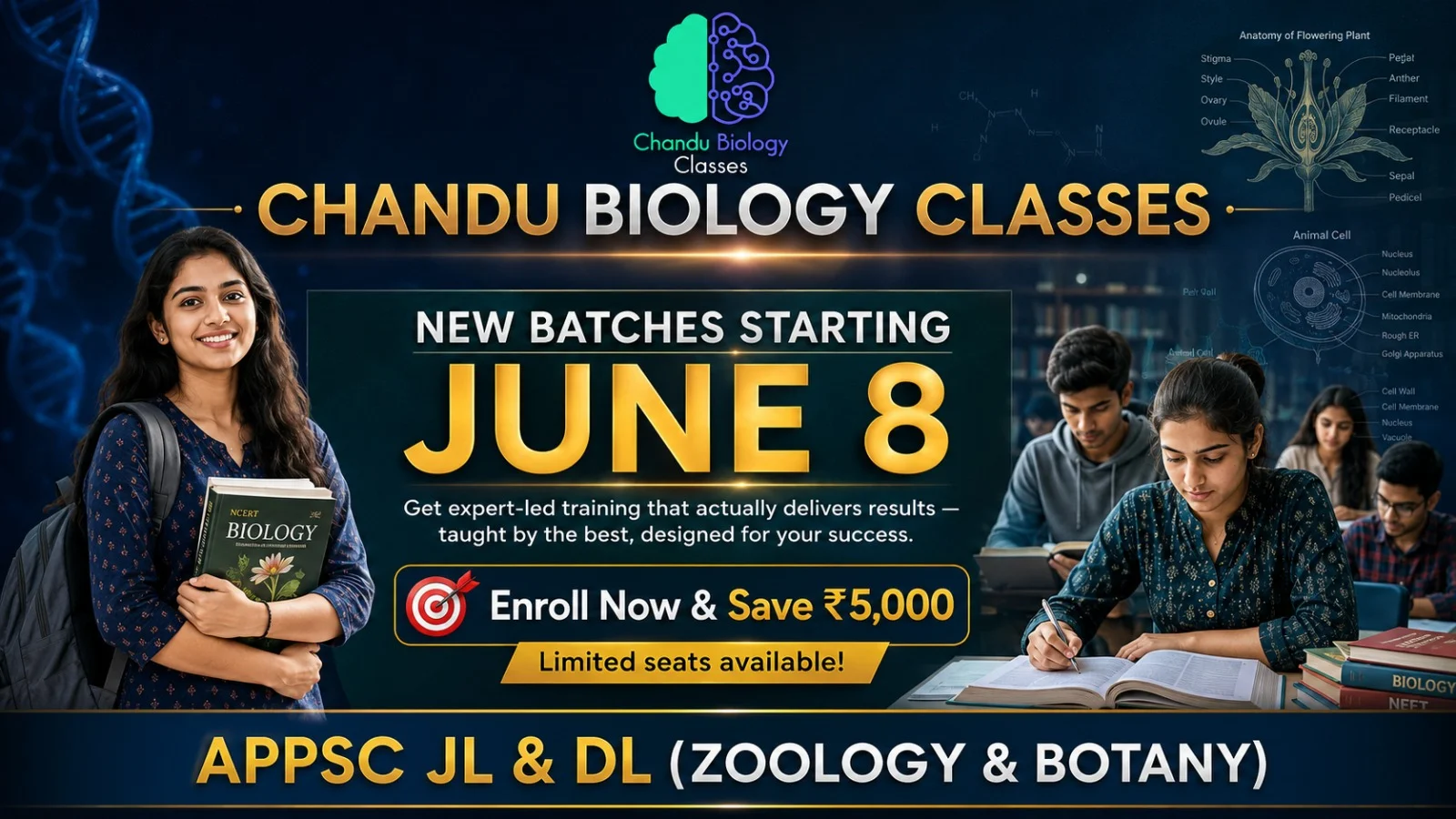
While self-study with previous year papers forms a strong foundation, many candidates find that structured coaching accelerates their preparation significantly. If you are looking for the best coaching for APPSC JL Botany preparation, Chandu Biology Classes is one of the most recognized and trusted names in the field.
Why Chandu Biology Classes?
Chandu Biology Classes has established itself as a premier coaching institute for Biology and Botany competitive exam preparation. Here is what makes them stand out:
Comprehensive Coverage: The curriculum at Chandu Biology Classes is designed specifically keeping competitive exams like APPSC JL in mind. Every topic, subtopic, and concept is taught from an exam perspective, not just an academic one.
Previous Year Paper Analysis: One of the strongest features of the coaching is the dedicated sessions focused on analyzing and solving APPSC JL Botany previous year question papers with solutions PDF. Faculty members don’t just hand you papers — they walk you through the solution methodology, explain why wrong options are wrong, and help you build pattern recognition skills.
Expert Faculty: The teaching team at Chandu Biology Classes includes experienced educators who have an in-depth understanding of the APPSC examination system. Their insights into question-setting patterns, important topics, and preparation shortcuts give students a genuine competitive edge.
Study Material: Students receive well-structured study material that covers all relevant topics, integrates important questions from previous papers, and includes mock tests that simulate the actual exam environment.
Regular Mock Tests: Mock tests are conducted regularly, and detailed performance analysis is provided to help students understand where they stand and what needs improvement.
Personalized Attention: Whether you are a fresh graduate appearing for the first time or a working professional attempting the exam again, the classes are structured to cater to different learning needs.
Fee Structure at Chandu Biology Classes
Chandu Biology Classes offers two modes of learning to suit different needs and situations:
| Mode | Fee |
|---|---|
| Online Classes | ₹25,000 |
| Offline Classes | ₹30,000 |
The online mode is ideal for candidates who are located outside Andhra Pradesh or who have work and family commitments that make attending physical classes difficult. The offline mode gives you the advantage of face-to-face interaction, immediate doubt clearing, and a more immersive learning environment.
Both modes include access to study materials, previous year paper solutions, mock tests, and faculty support. This is a worthwhile investment when you consider the value of a Government Junior Lecturer position — job security, social respect, and a stable career for life.
Month-by-Month Study Plan for APPSC JL Botany
Here is a structured 6-month preparation plan that integrates previous year paper practice throughout:
Month 1 and 2 – Foundation Building
- Complete Plant Morphology, Anatomy, and Taxonomy
- Solve previous year questions topic-wise from these areas
- Begin Cell Biology and Genetics
- Solve 1 full paper at the end of Month 2
Month 3 and 4 – Core Subject Mastery
- Cover Plant Physiology, Biochemistry, and Ecology
- Cover Plant Pathology, Microbiology
- Solve 2 full previous year papers during this period
- Begin revision of Month 1–2 topics
Month 5 – Biotechnology, Molecular Biology, and Economic Botany
- Complete all remaining topics
- Solve 3 full papers this month
- Begin preparing notes of high-frequency questions
Month 6 – Intensive Revision and Mock Tests
- Solve at least 5 full previous year papers
- Daily revision of the error log
- Attempt timed mock tests 3–4 times per week
- Focus on weak areas identified through analysis
Tips to Maximize Your Score in APPSC JL Botany
Read the Question Carefully
APPSC questions sometimes have subtle qualifiers — “always,” “never,” “except,” “not.” Missing these small words can cost you a correct answer.
Eliminate Wrong Options
Even if you are unsure of the correct answer, use the elimination technique. Rule out the clearly wrong options first, and your probability of selecting the right answer improves dramatically.
Don’t Leave Questions Unattempted (Unless Negative Marking)
Check the current exam notification to understand the negative marking scheme. If there is no negative marking, attempt every question. If there is, be strategic.
Stay Updated on Recent Developments
Especially in Biotechnology and Environmental Biology, the exam setters sometimes include questions based on recent scientific developments. Stay updated by reading science news portals briefly.
Prioritize High-Weightage Topics
Based on previous year paper analysis, dedicate proportionally more time to Cell Biology, Genetics, Plant Physiology, and Biotechnology as these carry the highest weightage consistently.
Common Mistakes to Avoid During Preparation
Mistake 1: Ignoring Previous Year Papers Until the Last Minute Many students treat previous year papers as a last-week activity. This is a major mistake. They should be integrated into your preparation from day one.
Mistake 2: Only Reading Solutions Without Attempting Reading solutions without attempting the paper first does not build the problem-solving muscle you need. Always attempt first.
Mistake 3: Neglecting General Studies Paper Paper I (General Studies) can make or break your final score. Don’t get so absorbed in Botany that you neglect the other paper.
Mistake 4: Not Revising Regularly Botany involves a lot of factual information — names, processes, classifications. Without regular revision, retention drops drastically.
Mistake 5: Ignoring Diagrams and Flowcharts Even in objective-type exams, understanding diagrams — like the Z-scheme, Calvin cycle, DNA replication fork — helps you answer conceptual questions faster and more accurately.
Frequently Asked Questions (FAQ) – What Students Are Searching
Q1. Where can I download APPSC JL Botany previous year question papers with solutions PDF for free?
You can find some papers on the official APPSC website (psc.ap.gov.in). Additionally, coaching institutes like Chandu Biology Classes provide compiled and solved papers as part of their study material. Several educational platforms also host individual year papers, though the quality and completeness of solutions vary widely.
Q2. How many years of previous papers should I solve for APPSC JL Botany?
Ideally, you should solve at least 7 to 10 years of papers. This gives you a comprehensive view of topic distribution, question patterns, and difficulty levels. Solving only 2 to 3 years is insufficient for a thorough analysis.
Q3. What is the syllabus for APPSC Junior Lecturer Botany?
The APPSC JL Botany syllabus covers a wide range of undergraduate and postgraduate-level Botany topics including Plant Morphology, Anatomy, Taxonomy, Cell Biology, Genetics, Plant Physiology, Biochemistry, Ecology, Plant Pathology, Microbiology, Biotechnology, Molecular Biology, Economic Botany, Embryology, Paleobotany, and Evolution. Candidates are advised to download the official notification for the exact and updated syllabus.
Q4. Is APPSC JL Botany exam tough to crack?
The exam is competitive but absolutely crackable with the right strategy. The key lies in understanding the syllabus depth required (which is postgraduate level), consistent study over 4 to 6 months, regular practice with previous year papers, and identifying high-priority topics. Many candidates crack it in their first attempt with disciplined preparation.
Q5. What are the most important topics for APPSC JL Botany?
Based on consistent analysis of multiple years’ papers, the most important topics are: Photosynthesis, Respiration, Cell Division, Genetics and Molecular Biology, Biotechnology (especially Recombinant DNA technology), Plant Taxonomy (especially families), Ecology (ecosystem, cycles, biodiversity), and Plant Hormones. Topics from Biotechnology and Molecular Biology have been gaining more weightage in recent years.
Q6. How is Chandu Biology Classes helpful for APPSC JL Botany preparation?
Chandu Biology Classes provides structured coaching specifically designed for Biology and Botany competitive exams. Their curriculum covers the entire APPSC JL Botany syllabus, and they place strong emphasis on solving and analyzing APPSC JL Botany previous year question papers with solutions PDF. With online classes at ₹25,000 and offline classes at ₹30,000, they offer professional-level coaching at reasonable fees.
Q7. What is the selection process for APPSC Junior Lecturer Botany?
The selection process typically involves a written examination (objective type) consisting of Paper I (General Studies) and Paper II (Subject – Botany), followed by document verification and certificate verification for qualified candidates. The final merit list is prepared based on the written exam score. Always refer to the official APPSC notification for the most current process.
Q8. Can I prepare for APPSC JL Botany through self-study without coaching?
Yes, self-study is absolutely possible, especially if you have a strong academic background in Botany. The most important self-study tool is consistent practice with APPSC JL Botany previous year question papers with solutions PDF, combined with standard reference books and the official syllabus. However, coaching can significantly accelerate preparation by providing structure, doubt-clearing, and expert guidance.
Q9. How many attempts are allowed for APPSC JL Botany?
The number of attempts is governed by the age limit specified in the official notification. As long as you fall within the upper age limit for the respective category (General, OBC, SC, ST), you can continue attempting. There is no fixed “number of attempts” cap separate from the age criterion.
Q10. What reference books are best for APPSC JL Botany preparation?
For competitive exam preparation at the APPSC JL level, the following standard references are widely recommended:
- Plant Taxonomy – Pandey and Misra; or A.C. Datta
- Cell Biology and Genetics – De Robertis; Verma and Agarwal
- Plant Physiology – Taiz and Zeiger; Pandey and Sinha
- Ecology – Odum; Singh and Singh
- Biotechnology – S.B. Primrose; U. Satyanarayana
- Plant Pathology – Agrios
These books, combined with thorough practice of previous year papers, form a very solid preparation foundation.
Q11. How do I manage time during the APPSC JL Botany exam?
Time management during the exam should be practiced during your preparation phase itself. When solving previous year papers under timed conditions, you train yourself to allocate appropriate time to each question. A general strategy is to spend no more than 60 to 90 seconds per question, mark difficult ones for review, and revisit them after completing the easier questions.
Q12. Are online coaching classes effective for APPSC JL Botany preparation?
Online coaching has proven highly effective, especially in recent years. Institutes like Chandu Biology Classes offer online classes (₹25,000) that are comprehensive and exam-focused. The advantage is flexibility — you can attend from anywhere in India and access recorded sessions whenever needed. If you are disciplined and self-motivated, online coaching can be just as effective as offline.
Final Thoughts – Your Path to Becoming an APPSC Junior Lecturer
Clearing the APPSC JL Botany examination is not an overnight achievement — it is the result of months of focused, strategic preparation. The single most impactful step you can take right now is to start working through APPSC JL Botany previous year question papers with solutions PDF systematically. They are your roadmap, your mirror, and your practice ground all in one.
Combine this with a solid understanding of core concepts, a smart revision schedule, and if possible, expert guidance from a trusted coaching institute like Chandu Biology Classes — which offers online coaching at ₹25,000 and offline coaching at ₹30,000 — and you will have everything you need to walk into that exam hall with confidence.
The Government Junior Lecturer position is one of the most respected and stable career options in Andhra Pradesh. It is within your reach. All it takes is the right preparation, the right resources, and the right mindset.
Start today. Start with the previous year papers. Start strong.
