
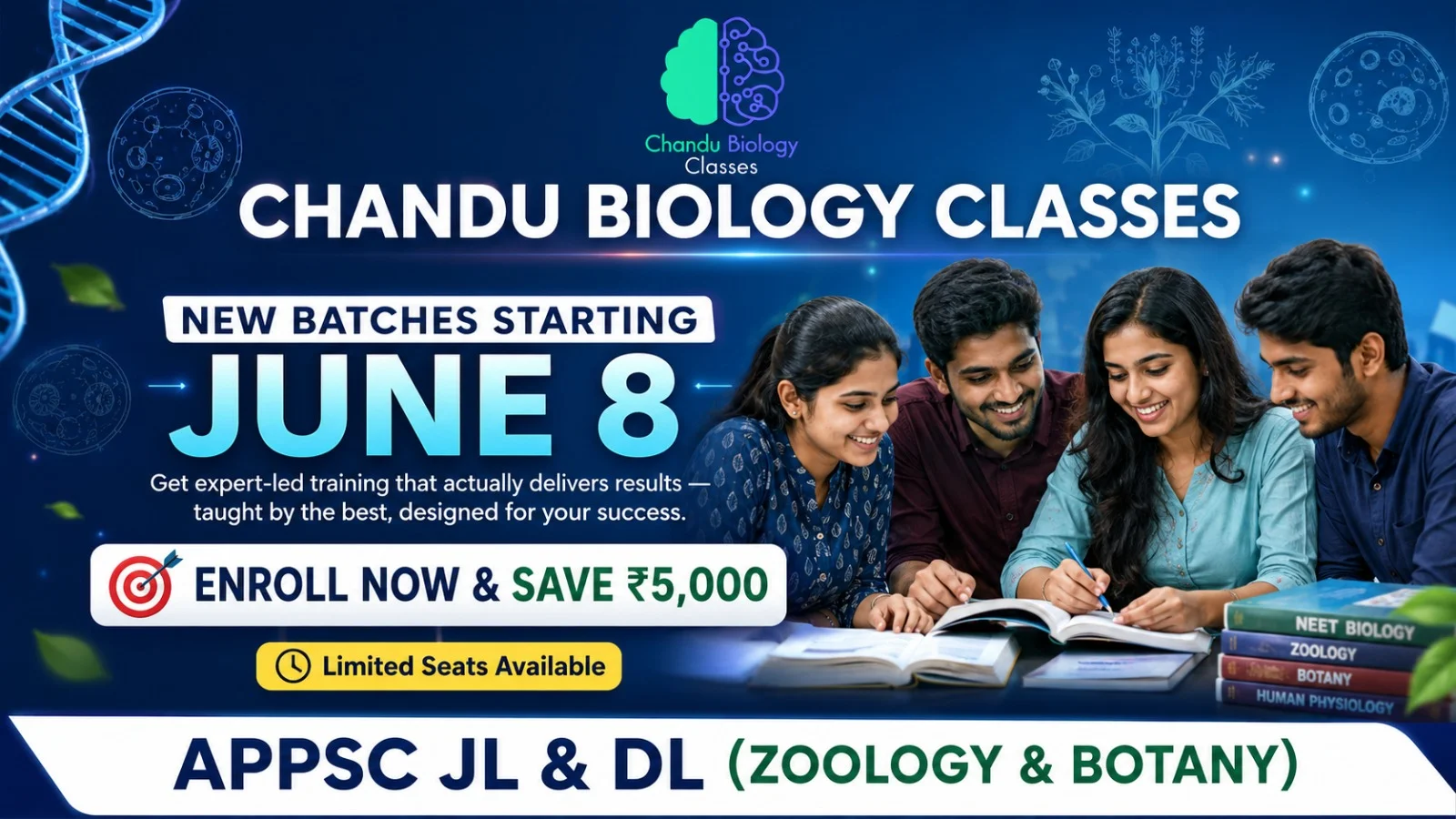
If you’ve been searching for a reliable, detailed, and practical APPSC Assistant Professor Biology Paper II III preparation guide, you’ve finally found the right place. Whether you’re a fresh postgraduate or someone who has been preparing for a while, this guide is designed to give you a clear, step-by-step roadmap — covering the syllabus breakdown, smart study strategies, important topics, reference books, and the best coaching options available, including the highly recommended Chandu Biology Classes.
The APPSC (Andhra Pradesh Public Service Commission) Assistant Professor recruitment is one of the most competitive and prestigious exams for biology graduates in Andhra Pradesh. Getting your preparation strategy right from day one can make the difference between cracking it in the first attempt and spending another year preparing.
Let’s get into every detail you need.
Understanding the APPSC Assistant Professor Exam Structure
Before diving into preparation, you must clearly understand how the exam is structured. The APPSC Assistant Professor exam for Biology consists of three papers:
Paper I covers general studies, teaching aptitude, and research methodology — common across all subjects.
Paper II is subject-specific and tests your core knowledge of biology at the UG level. This paper tests foundational knowledge in botany, zoology, microbiology, genetics, biochemistry, ecology, and cell biology.
Paper III goes deeper, focusing on postgraduate-level knowledge in your chosen stream. This is where the exam really separates serious candidates from casual ones. Topics include molecular biology, biotechnology, physiology, evolution, biodiversity, and current developments in life sciences.
Both Paper II and Paper III are objective-type (MCQ) exams, carrying significant weightage. The total marks and time duration can vary slightly with each notification, so always refer to the latest official notification from APPSC.
Understanding this structure is the first step in building an effective APPSC Assistant Professor Biology Paper II III preparation guide strategy.
Detailed Syllabus Breakdown for Paper II
Paper II for Biology is vast but manageable when broken down systematically. Here are the major units you need to master:
Cell Biology and Genetics Cell structure and function, cell division (mitosis and meiosis), DNA replication, transcription, translation, gene expression regulation, Mendelian genetics, chromosomal theory of inheritance, mutations, and linkage.
Botany Plant morphology, anatomy, physiology (photosynthesis, respiration, transpiration, mineral nutrition), plant reproduction, economic botany, and taxonomy including classification systems.
Zoology Animal diversity, morphology and physiology of invertebrates and vertebrates, comparative anatomy, animal behavior, developmental biology, and organ system functions.
Microbiology Bacteria, viruses, fungi, protozoa, microbiological techniques, microbial metabolism, and applied microbiology.
Ecology and Environment Ecosystem structure and function, biogeochemical cycles, ecological succession, biodiversity, environmental pollution, conservation biology, and global environmental issues.
Biochemistry Carbohydrates, proteins, lipids, vitamins, enzymes, metabolic pathways (glycolysis, Krebs cycle, electron transport chain), and nucleic acid chemistry.
This paper requires conceptual clarity and breadth of knowledge across multiple disciplines, making consistent daily study essential.
Detailed Syllabus Breakdown for Paper III
Paper III is where specialization matters. The content is more advanced and application-oriented. Here’s a breakdown of key areas:
Molecular Biology and Biotechnology Recombinant DNA technology, PCR, DNA sequencing, gene cloning, vectors, CRISPR-Cas9, transgenic organisms, bioinformatics basics, genomics, and proteomics.
Physiology (Plant and Animal) Hormonal regulation in plants and animals, nervous system physiology, endocrine system, digestive physiology, reproductive physiology, stress physiology, and homeostasis.
Evolution and Systematics Darwin’s theory, modern synthetic theory, molecular evolution, phylogenetics, cladistics, speciation, and biogeography.
Immunology Innate and adaptive immunity, antibodies, antigen-antibody reactions, MHC, immunological disorders, and vaccines.
Reproductive Biology and Developmental Biology Gametogenesis, fertilization, cleavage, gastrulation, organogenesis, developmental genetics, stem cells, and regeneration.
Current Topics in Life Sciences This section often includes emerging areas such as epigenetics, microbiome research, cancer biology, RNA interference, and biosafety regulations. Keeping up with current scientific literature gives you an edge here.
Month-by-Month Preparation Strategy
One of the most commonly asked questions when looking for an APPSC Assistant Professor Biology Paper II III preparation guide is how to plan the months of preparation effectively. Here’s a practical month-by-month approach assuming you have 6–8 months:
Months 1–2: Foundation Building Focus on Paper II topics — especially cell biology, genetics, and ecology, since these form the base for Paper III as well. Read standard textbooks and make concise notes. Avoid relying on shortcuts at this stage.
Months 3–4: Paper III Depth Study Shift your primary focus to Paper III topics. Molecular biology and biotechnology need extra time because the questions are highly specific and application-based. Start solving previous year question papers for topic familiarity.
Months 5–6: Revision and Mock Tests Begin intensive revision. Solve full-length mock tests under timed conditions. Identify weak areas and revisit them with focused study sessions. Join test series — either online or offline — to simulate exam pressure.
Final Weeks: Smart Revision At this point, avoid picking up new material. Revise your notes, focus on high-weightage topics, practice MCQ speed, and ensure you’re mentally and physically prepared.
Important Books and Study Resources
The right study materials can significantly accelerate your preparation. Here are the most recommended books:
For Paper II:
- Molecular Biology of the Cell — Alberts et al.
- Lehninger Principles of Biochemistry — Nelson and Cox
- Ecology — Odum
- An Introduction to Plant Taxonomy — C.R. Metcalfe
- Cell and Molecular Biology — Gerald Karp
For Paper III:
- Molecular Biology — David Freifelder
- Immunology — Kuby
- Genetics — Lewin’s Genes
- Biotechnology — B.D. Singh
- Developmental Biology — Scott F. Gilbert
For Previous Year Papers and Practice: Always collect at least 10 years of APPSC and other state PSC question papers. These give you a clear picture of the question pattern, difficulty level, and frequently tested topics.
Why Coaching Matters: About Chandu Biology Classes
Self-study works for disciplined candidates, but the right coaching can cut months off your preparation time. In Andhra Pradesh, one name that stands out strongly in biology competitive exam coaching is Chandu Biology Classes.
Chandu Biology Classes is known for its focused, exam-oriented teaching methodology specifically tailored for APPSC Assistant Professor candidates. The faculty brings deep subject expertise combined with a practical understanding of what the exam demands. Unlike generic science coaching, Chandu Biology Classes covers both Paper II and Paper III comprehensively, making it a go-to choice for serious aspirants.
What makes Chandu Biology Classes stand out:
The teaching is concept-first, not rote-memorization-first. Students are made to understand the logic behind biological processes, which helps them answer application-based MCQs confidently rather than blindly guessing.
The class structure follows the APPSC syllabus rigorously, with topic-wise coverage, regular assessments, and doubt-clearing sessions. Students report that the notes provided are highly exam-relevant and comprehensive enough to reduce dependency on multiple textbooks.
Mock tests and previous year paper analysis are built into the program, ensuring students are prepared not just in terms of content but also exam strategy and time management.
Fee Structure:
- Online Batch: ₹25,000
- Offline Batch: ₹30,000
This pricing is transparent and competitive given the depth of content and support provided. For aspirants from outside Andhra Pradesh or those unable to relocate, the online batch is an excellent option that doesn’t compromise on quality.
If you’re serious about cracking APPSC Assistant Professor Biology and want structured guidance, Chandu Biology Classes is worth every rupee.
Topic-Wise Weightage: Where to Focus Your Energy
Not all topics carry equal weightage. Based on an analysis of previous APPSC and similar state PSC papers in biology, here’s a general picture of high-priority topics:
Very High Priority (More Questions, Year After Year):
- Cell division and DNA replication
- Photosynthesis and respiration
- Recombinant DNA technology and PCR
- Gene regulation in prokaryotes and eukaryotes
- Ecology and ecosystem dynamics
- Mendelian genetics and chromosomal inheritance
High Priority:
- Biotechnology applications
- Immunology — antibodies and immune response
- Plant physiology — hormones and tropisms
- Animal physiology — nervous system and endocrine system
- Evolution — theories and molecular evidence
Moderate Priority:
- Taxonomy and classification
- Developmental biology
- Microbial metabolism
- Biostatistics and research methodology
Don’t ignore moderate-priority topics entirely — even a single extra question answered correctly can determine your rank.
Common Mistakes Candidates Make
Even well-prepared candidates make avoidable mistakes. Learning from these can give you a significant edge:
Ignoring Paper I — Many candidates underestimate Paper I (Teaching Aptitude and Research Methodology). It carries significant marks and can tilt the final score in your favor if you score well. Dedicate at least one hour per day to Paper I.
Studying theory without practicing MCQs — The APPSC exam is MCQ-based. You could know a topic deeply but still lose marks if you’re not used to applying that knowledge quickly under exam conditions. Practice MCQs daily, not just in the final weeks.
Not tracking syllabus completion — Without a progress tracker, you’ll unknowingly spend too much time on topics you already know while leaving other topics untouched. Maintain a study planner and check off completed topics.
Avoiding difficult topics — Molecular biology, immunology, and biotechnology are areas many candidates avoid because they feel complex. But these topics regularly appear in Paper III. Instead of avoiding them, join a coaching program like Chandu Biology Classes that makes these topics accessible and exam-ready.
Last-minute material switching — Don’t pick up a new book in the final month of preparation. Stick to your notes and previously studied material. Deep revision of what you already know is far more effective than adding new content late in your preparation.
How to Approach MCQs Smartly
APPSC Paper II and Paper III are MCQ-based. Here are proven strategies for MCQ performance:
Elimination first — For questions you’re not fully sure about, eliminate obviously wrong options. Even narrowing from 4 to 2 options significantly improves your probability of getting it right.
Don’t overthink straightforward questions — Many MCQs are direct knowledge-based. If you know the answer immediately, mark it and move on without second-guessing yourself.
Beware of negatively worded questions — Questions like “which of the following is NOT correct” are easy to misread under time pressure. Underline the word NOT in your mind before answering.
Time allocation — Divide your time proportionally. If you have 150 questions in 150 minutes, that’s one minute per question. Practice this pace in mock tests.
Come back to doubtful questions — Mark uncertain questions and return to them only after completing all the questions you’re confident about.
Tips for the Final 30 Days
The last month is where most of your rank improvement happens. Here’s how to use it:
Give at least 3 full-length mock tests per week under timed, exam-like conditions. After each mock test, spend equal time analyzing your performance — don’t just focus on the score but on understanding every question you got wrong.
Revise high-priority topics daily. Use flashcards or concept maps for quick recall of definitions, mechanisms, and key facts.
For Paper III, revisit molecular biology diagrams and processes — understanding the sequence of steps in processes like DNA replication, protein synthesis, and immune responses is critical.
Stay updated on recent developments in biology. Current topics in biotechnology, public health biology, and environmental science occasionally appear in questions and can give you an edge over candidates who stick strictly to textbooks.
Frequently Asked Questions (FAQs)
What is the syllabus for APPSC Assistant Professor Biology Paper II and Paper III? Paper II covers cell biology, genetics, botany, zoology, microbiology, biochemistry, and ecology at the UG level. Paper III covers molecular biology, biotechnology, physiology, immunology, evolution, developmental biology, and advanced life sciences at the PG level. Both are MCQ-based objective papers.
How many months are needed to prepare for APPSC Assistant Professor Biology? Ideally, 6 to 8 months of structured preparation is sufficient for a well-focused candidate. However, candidates with strong postgraduate foundations may manage in 4–5 months with intensive preparation and good coaching support like Chandu Biology Classes.
Is coaching necessary for APPSC Assistant Professor Biology? Coaching is not mandatory, but it significantly accelerates preparation, especially for Paper III topics like molecular biology and biotechnology. Coaching programs like Chandu Biology Classes provide structured syllabi, regular assessments, and expert guidance that self-study alone may not offer as efficiently.
What is the fee for Chandu Biology Classes for APPSC preparation? Chandu Biology Classes offers an online batch for ₹25,000 and an offline batch for ₹30,000. The fee includes comprehensive coverage of both Paper II and Paper III topics.
Which books are best for APPSC Assistant Professor Biology Paper III? Some of the best books for Paper III include Lewin’s Genes for molecular genetics, Kuby’s Immunology, Scott Gilbert’s Developmental Biology, David Freifelder’s Molecular Biology, and B.D. Singh’s Biotechnology. Supplement these with short notes and practice question papers.
Are previous year question papers helpful for APPSC Assistant Professor Biology? Yes, extremely. Previous year papers reveal the exam pattern, frequently tested topics, and the difficulty level of questions. Solving 8–10 years of previous papers is one of the most effective preparation strategies.
How difficult is APPSC Assistant Professor Biology compared to NET/GATE? APPSC Assistant Professor Biology is comparable in difficulty to CSIR-UGC NET in many topic areas, especially for Paper III. Candidates who have already cleared NET often find APPSC preparation easier since the content overlaps significantly, though the focus shifts to Andhra Pradesh-specific educational contexts in some sections.
Can I prepare for APPSC Assistant Professor Biology online? Yes, online preparation is fully viable. Several quality resources are available online, and coaching institutes like Chandu Biology Classes offer dedicated online batches at ₹25,000 that cover the entire syllabus with live sessions, recorded lectures, and test series.
What is the marking scheme for APPSC Assistant Professor Biology papers? The exact marking scheme is announced in each official notification. Typically, each correct answer carries equal positive marks, and there may or may not be negative marking depending on the exam year. Always verify this in the current official APPSC notification before your exam.
How should I manage my time between Paper II and Paper III preparation? A good general approach is to spend roughly 40% of your preparation time on Paper II and 60% on Paper III, since Paper III is more content-intensive and requires deeper understanding. Adjust this ratio based on your existing strengths and weaknesses after an initial self-assessment.
Final Word
Cracking the APPSC Assistant Professor Biology exam is absolutely achievable with the right plan, consistent effort, and quality resources. This APPSC Assistant Professor Biology Paper II III preparation guide has given you everything from syllabus clarity to smart study strategies, book recommendations, mock test tips, and the best coaching option available.
Whether you choose to prepare independently or join a structured coaching program like Chandu Biology Classes — which offers online classes at ₹25,000 and offline classes at ₹30,000 — the key is consistency and systematic coverage of both papers.
Start today, stay consistent, and approach every study session with the mindset that your preparation is your competitive advantage. The seat is there — your preparation will determine who fills it.
Best of luck with your APPSC Assistant Professor Biology Paper II III journey.
