
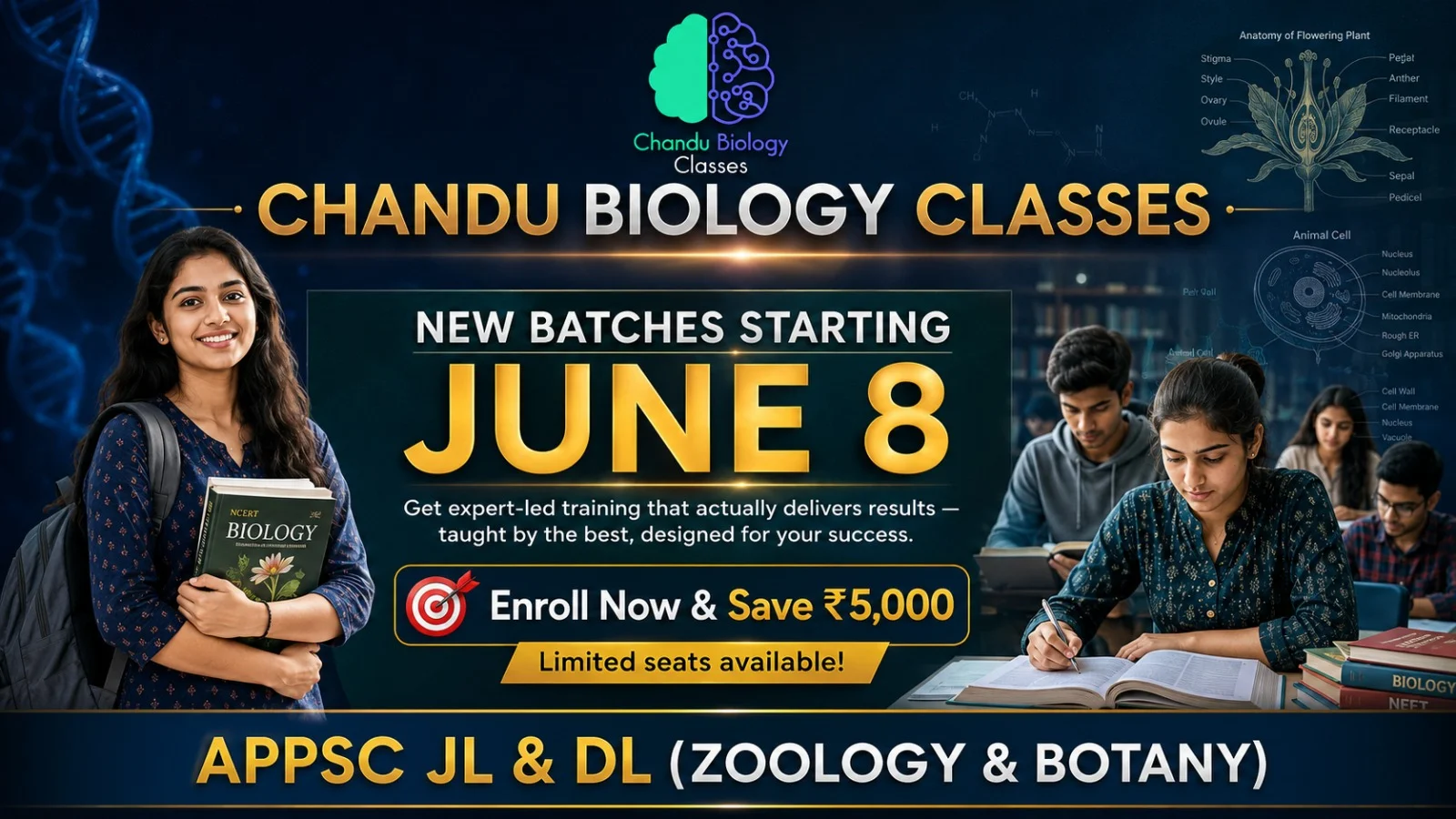
If you’ve been searching for the best way to prepare for the APPSC Junior Lecturer Biology exam, you’ve landed on the right page. This in-depth guide covers everything from the exam pattern, syllabus breakdown, preparation strategy, and most importantly — how to access the APPSC JL Biology free demo class online 2026 to kickstart your journey without spending a single rupee upfront.
Whether you’re a fresh postgraduate in Biology or someone who has been preparing for a while without direction, this article will serve as your go-to roadmap. Let’s dive deep.
What Is APPSC JL Biology? Understanding the Basics
The Andhra Pradesh Public Service Commission (APPSC) conducts the Junior Lecturer recruitment exam to fill vacancies in Government Junior Colleges across the state. Biology is one of the most competitive and sought-after subjects in this exam.
A Junior Lecturer in Biology is responsible for teaching Intermediate students (Class 11 and 12 equivalent) and plays a critical role in shaping the academic foundation of thousands of young students every year.
Why Is APPSC JL Biology So Competitive?
- Large number of applicants every year
- Limited number of vacancies in the Biology subject
- The syllabus covers both Botany and Zoology at degree and postgraduate level
- Paper II (Subject Paper) tests in-depth conceptual understanding
- General Studies and Mental Ability sections also carry significant weight
The competition is real, and the only way to rise above it is with structured, expert-guided preparation.
APPSC JL Biology 2026: Exam Pattern You Must Know
Before jumping into preparation, every serious candidate must understand the exam structure.
Paper I – General Studies and Mental Ability
| Section | Topics Covered | Marks |
|---|---|---|
| General Studies | Current Affairs, History, Polity, Economy, Science | 75 |
| Mental Ability | Reasoning, Aptitude, Data Interpretation | 75 |
| Total | 150 |
Paper II – Biology (Subject Paper)
| Section | Topics Covered | Marks |
|---|---|---|
| Part A | Botany – Cell Biology, Genetics, Ecology, Plant Physiology | 120 |
| Part B | Zoology – Animal Kingdom, Physiology, Genetics, Evolution | 120 |
| Total | 240 |
Key Exam Details
- Mode of Exam: Offline (OMR-based)
- Duration: 2.5 hours per paper
- Negative Marking: 1/3rd mark deducted for wrong answers
- Language: English and Telugu (bilingual)
Understanding this structure is the first step. The next step is finding quality coaching, and that’s exactly where trying an APPSC JL Biology free demo class online 2026 becomes a game-changer.
APPSC JL Biology Syllabus 2026: Complete Topic-Wise Breakdown
Botany Topics (Paper II – Part A)
1. Cell Biology and Molecular Biology
- Cell structure and function
- Cell cycle: Mitosis and Meiosis
- DNA structure, replication, transcription, and translation
- Genetic code and protein synthesis
- Mutations and their types
- Recombinant DNA technology and its applications
2. Genetics and Evolution
- Mendelian genetics and its extensions
- Chromosomal theory of inheritance
- Linkage and crossing over
- Sex determination mechanisms
- Population genetics and Hardy-Weinberg equilibrium
- Darwinism, Neo-Darwinism, and Modern Synthetic Theory
3. Plant Physiology
- Photosynthesis: Light and dark reactions
- Respiration: Glycolysis, Krebs cycle, Electron Transport Chain
- Mineral nutrition and nitrogen fixation
- Growth regulators and their applications
- Seed germination and dormancy
4. Plant Taxonomy and Systematics
- Bentham and Hooker’s classification
- Angiosperm families: Fabaceae, Solanaceae, Liliaceae
- ICBN nomenclature rules
- Phylogenetic classification systems
5. Ecology and Environmental Biology
- Ecosystems, food chains, food webs
- Biogeochemical cycles
- Biodiversity and conservation
- Environmental pollution and its remediation
- Climate change and global warming
6. Biotechnology
- Recombinant DNA technology
- PCR and its applications
- Transgenic plants and animals
- CRISPR-Cas9 gene editing
- Bioinformatics basics
Zoology Topics (Paper II – Part B)
1. Animal Kingdom and Diversity
- Classification of animals up to phylum level
- Non-chordate phyla: Porifera, Cnidaria, Platyhelminthes, Nematoda, Annelida, Arthropoda, Mollusca, Echinodermata
- Chordate classes and their distinguishing features
- Comparative anatomy and evolutionary relationships
2. Cell Biology (Animal Perspective)
- Cell organelles and their functions
- Plasma membrane structure and transport
- Cell signaling pathways
- Apoptosis and necrosis
3. Animal Physiology
- Digestion and absorption in humans
- Circulatory system: Heart structure, blood composition, blood groups
- Respiratory system and gas exchange
- Excretory system and osmoregulation
- Nervous system: Neuron structure, impulse transmission, synaptic transmission
- Endocrine system: Hormones and their actions
- Reproductive system and reproductive physiology
4. Developmental Biology
- Gametogenesis: Spermatogenesis and Oogenesis
- Fertilization and early embryonic development
- Gastrulation and organogenesis
- Metamorphosis in insects and amphibians
- Stem cells and regeneration
5. Genetics and Molecular Biology (Animal)
- Gene expression regulation
- Epigenetics and its significance
- Genomics and proteomics
- Genetic diseases in humans
6. Evolution and Ecology
- Theories of organic evolution
- Evidence for evolution
- Speciation and reproductive isolation
- Behavioral ecology
- Conservation biology
Why Most APPSC JL Biology Aspirants Fail: The Honest Truth
Many candidates who appear for the APPSC JL Biology exam year after year without success share a common set of problems:
1. No Structured Study Plan They study randomly without following the official syllabus systematically. Topics get repeated unnecessarily while other crucial areas remain untouched.
2. Over-reliance on Standard Textbooks Alone Reading NCERT, Veer Bala Rastogi, or P.S. Verma is necessary but not sufficient. Exam-specific preparation requires understanding the question pattern, frequently asked topics, and how to apply concepts in MCQ format.
3. No Mock Tests or Previous Year Paper Practice Without regular mock tests, candidates never develop the time management skills needed to complete 150–240 questions within a strict time limit.
4. Lack of Expert Guidance Self-study has its limits. When doubts remain unresolved, concepts stay weak. Expert mentors can identify gaps and help aspirants course-correct quickly.
5. No Knowledge of Current Exam Trends APPSC updates its question patterns. Without staying current on what’s being asked in recent exams, candidates may prepare outdated content.
The solution to all of these problems lies in enrolling with experienced, exam-focused coaching — or at the very least, starting by attending an APPSC JL Biology free demo class online 2026 to assess what structured coaching feels like.
Chandu Biology Classes: The Most Trusted Name for APPSC JL Biology Preparation
When it comes to APPSC JL Biology coaching in Andhra Pradesh and Telangana, one name consistently comes up among toppers, serious aspirants, and educators — Chandu Biology Classes.
Who Is Behind Chandu Biology Classes?
Chandu Biology Classes is run by an expert Biology educator with years of experience specifically in preparing students for competitive exams including APPSC JL, TSPSC JL, and related Biology-based recruitment exams. The teaching methodology is deeply rooted in conceptual clarity, exam-oriented strategy, and consistent revision.
What Makes Chandu Biology Classes Stand Apart?
1. APPSC-Specific Curriculum Unlike generic science coaching centers, Chandu Biology Classes designs its entire program around the APPSC JL Biology syllabus. Every topic covered is directly mapped to what gets asked in the exam.
2. Bilingual Teaching (Telugu + English) Since most APPSC aspirants are most comfortable in Telugu, classes are taught bilingually. Complex biological concepts are explained in simple Telugu alongside technical English terminology, making understanding deeper and faster.
3. Previous Year Question Analysis Every batch begins with a thorough analysis of previous year question papers. Students understand which topics carry more weight, where the tricks lie, and what kind of answers the commission expects.
4. Regular Mock Tests and Performance Tracking Weekly tests, subject-wise tests, and full-length mock exams are conducted regularly. Detailed performance analysis is provided so every student knows their strengths and areas for improvement.
5. Current Affairs Integration for Paper I Paper I (General Studies) is often the deciding factor between selection and rejection. Chandu Biology Classes integrates current affairs and General Studies preparation alongside the core Biology content.
6. Doubt Resolution Sessions After every major topic, dedicated doubt-clearing sessions ensure no student moves forward with unresolved confusion.
7. Study Material Comprehensive, exam-focused study material is provided that compiles the most important concepts, diagrams, and questions from reliable sources — saving students hundreds of hours of research time.
Chandu Biology Classes Fee Structure 2026
Investing in the right coaching is one of the smartest decisions a serious aspirant can make. Here’s the transparent fee structure for Chandu Biology Classes:
| Mode of Coaching | Fee Structure |
|---|---|
| Online Coaching | ₹25,000/- |
| Offline Coaching | ₹30,000/- |
What Does the Fee Include?
Online Batch (₹25,000/-)
- Live interactive classes via digital platform
- Recorded sessions for revision access
- Digital study material
- Online mock tests and performance analytics
- Doubt clearing sessions via live Q&A
- Access to all topic-wise tests and full-length mocks
- Direct mentorship from expert faculty
Offline Batch (₹30,000/-)
- In-person classroom teaching
- Printed study material
- Physical mock tests
- Face-to-face doubt resolution
- Peer learning environment
- Regular revision sessions
- Direct interaction with faculty during and after class
Both batches offer exceptional value for the depth of preparation provided. Given that selection as APPSC JL Biology comes with a government job, job security, and a respectable salary package, the investment is absolutely worthwhile.
How to Access APPSC JL Biology Free Demo Class Online 2026 at Chandu Biology Classes
One of the most student-friendly aspects of Chandu Biology Classes is the availability of a free demo class before enrollment. This allows aspirants to:
- Experience the teaching quality firsthand
- Understand the depth of content coverage
- Evaluate whether the teaching style suits their learning preference
- Ask questions directly to the faculty
- Decide confidently about enrollment
Steps to Join the Free Demo
- Visit the official page or contact Chandu Biology Classes through their social media handles or YouTube channel
- Register your interest by sharing your name, contact number, and preferred batch timing
- Attend the free demo class online through the shared link
- Interact with the faculty, ask your questions, and evaluate the session
- Decide on enrollment based on your experience
The APPSC JL Biology free demo class online 2026 from Chandu Biology Classes is designed to be genuinely informative and not just a promotional exercise. Students who attend often report that even the free session gives them clarity on key topics.
Month-by-Month Study Plan for APPSC JL Biology 2026
Here’s a realistic, structured 6-month preparation plan for candidates starting fresh:
Month 1: Foundation Building
- Complete Cell Biology and Molecular Biology (Both Botany and Zoology)
- Study Mendelian Genetics and Molecular Genetics
- Start General Studies – History and Polity
- Solve 50 previous year MCQs per week
Month 2: Core Physiology
- Plant Physiology: Photosynthesis, Respiration, Growth Regulators
- Animal Physiology: Digestion, Circulation, Respiration, Excretion
- Nervous System and Endocrine System
- Continue General Studies – Economy and Current Affairs
- Solve 100 previous year MCQs per week
Month 3: Diversity and Taxonomy
- Animal Kingdom – Non-chordates and Chordates
- Plant Taxonomy and Classification Systems
- Ecology: Ecosystems, Biodiversity, Pollution, Conservation
- Mental Ability and Reasoning practice (30 minutes daily)
- Attempt first subject-wise mock test
Month 4: Advanced Topics and Biotechnology
- Developmental Biology: Gametogenesis, Fertilization, Embryology, Metamorphosis
- Biotechnology: Recombinant DNA, PCR, Transgenic Organisms, CRISPR
- Evolution: Theories, Evidence, Speciation
- Second subject-wise mock test
- Revise Month 1 and 2 topics
Month 5: Intensive Revision and Mock Tests
- Full syllabus revision (focus on weak areas identified from mock tests)
- Daily MCQ practice: minimum 150 questions per day
- Two full-length mock tests per week
- Revise previous year papers in timed conditions
- General Studies intensive revision
Month 6: Final Preparation and Exam Strategy
- Speed and accuracy drills
- One full mock test daily (alternating Paper I and Paper II)
- Final revision of important diagrams and definitions
- Mental preparation and stress management
- Review of exam day strategy and time allocation
Important Tips for APPSC JL Biology Paper II
Focus on Diagram-Based Understanding Even though the exam is MCQ-based, many questions are rooted in understanding diagrams — mitosis stages, heart anatomy, nephron structure, chloroplast structure, etc. Drawing and understanding diagrams aids memory retention.
Master the High-Weightage Topics First Based on previous year analysis, Cell Biology, Genetics, Animal Physiology, and Ecology carry consistently higher weightage. Ensure these are your strongest areas.
Never Ignore Paper I Candidates often score very similarly in the subject paper. Paper I (General Studies and Mental Ability) can be the deciding factor. Allocate at least 30% of your daily study time to it.
Understand Negative Marking With 1/3rd negative marking, attempting every question blindly is dangerous. Practice identifying your confidence level in answering each question during mock tests.
Use Multiple Revision Cycles The human brain retains information better through spaced repetition. Revise each topic at least 3–4 times across your preparation period.
Why 2026 Is the Right Time to Start Preparing
New Notification Expected APPSC has been releasing Junior Lecturer notifications with increasing frequency. The 2026 cycle is expected to have a significant number of vacancies given the backlog of unfilled positions across government junior colleges in Andhra Pradesh.
More Online Resources Than Ever The availability of online platforms, video lectures, and digital mock tests means even candidates from smaller towns and villages can access top-quality coaching. Attending an APPSC JL Biology free demo class online 2026 has never been easier or more accessible.
Competitive Landscape Is Evolving As more aspirants start preparing earlier with structured coaching, the average quality of preparation in the candidate pool is rising. Starting now in 2026 gives you a head start over those who wait for the official notification.
Student Success Stories from Chandu Biology Classes
Many students who have previously attended APPSC JL Biology free demo class online 2026 sessions and subsequently enrolled with Chandu Biology Classes have gone on to clear the exam. Their feedback consistently highlights:
- The clarity of biological concept explanations
- The exam-focused approach that eliminates unnecessary content
- The motivational support during the long preparation journey
- The quality and comprehensiveness of the study material
- The genuine commitment of the faculty to student success
These success stories are a testament to what structured, expert-guided preparation can achieve.
Frequently Asked Questions (FAQ) — Trending Searches by Students
1. Is there any free demo class available for APPSC JL Biology 2026?
Yes. Chandu Biology Classes offers a free demo class for APPSC JL Biology aspirants both online. Students can attend the session, evaluate the teaching quality, and decide about enrollment. The APPSC JL Biology free demo class online 2026 is available to all interested candidates without any prior commitment.
2. What is the syllabus for APPSC JL Biology 2026?
The APPSC JL Biology syllabus covers Botany and Zoology at degree and postgraduate level. Major topics include Cell Biology, Genetics, Molecular Biology, Plant and Animal Physiology, Ecology, Biotechnology, Developmental Biology, Taxonomy, and Evolution. Paper I covers General Studies and Mental Ability.
3. How many times can I attempt APPSC JL Biology exam?
There is no fixed limit on the number of attempts for APPSC JL exam. However, age limit conditions apply. The general upper age limit is typically 42 years (with relaxations for reserved categories). Candidates can continue to appear as long as they are within the eligible age bracket.
4. What is the salary of APPSC Junior Lecturer Biology?
An APPSC Junior Lecturer (Biology) earns a basic pay in the range of ₹35,120 – ₹87,130 per month under Pay Level applicable to AP Government Junior College Lecturers, plus additional allowances including DA, HRA, and other government benefits. The gross salary at entry level is approximately ₹45,000 – ₹55,000 per month depending on posting location.
5. Which books are best for APPSC JL Biology preparation?
Recommended books include:
- Cell Biology: De Robertis, Karp’s Cell and Molecular Biology
- Genetics: Lewin’s Genes, Strickberger’s Genetics
- Botany: Veer Bala Rastogi (all volumes)
- Zoology: P.S. Verma and V.K. Agarwal
- Ecology: Odum’s Fundamentals of Ecology
- Previous Year Papers: APPSC JL Biology previous year compilations (available through coaching institutes like Chandu Biology Classes)
6. How long does it take to prepare for APPSC JL Biology?
A dedicated aspirant with a Biology postgraduate background typically needs 6 to 12 months of structured preparation. Those who combine self-study with expert coaching (like Chandu Biology Classes) tend to reduce this timeline significantly while improving accuracy.
7. Is online coaching as effective as offline coaching for APPSC JL Biology?
Yes, online coaching has proven equally effective — especially when the platform provides live interactive classes, recorded sessions, regular mock tests, and doubt-clearing support. Chandu Biology Classes offers both online (₹25,000) and offline (₹30,000) options with the same quality of content delivery.
8. What is the selection process for APPSC JL Biology?
The selection process typically involves:
- Written Examination (Paper I + Paper II)
- Document Verification
- Final Merit List based on combined score
There is no interview round for APPSC JL posts. The final selection is entirely based on written exam performance and document verification.
9. What is the difference between APPSC JL and TSPSC JL Biology exams?
APPSC JL is conducted by the Andhra Pradesh Public Service Commission for AP Government Junior Colleges, while TSPSC JL is conducted by the Telangana State Public Service Commission for Telangana Government Junior Colleges. Both exams share similar Biology syllabi, though exam patterns, vacancy numbers, and specific topic emphases may differ. Candidates from both states can often use the same preparation with minor adjustments.
10. How can I join Chandu Biology Classes for APPSC JL preparation?
You can join by first attending the free demo class to evaluate the coaching quality. Contact Chandu Biology Classes through their official social media handles or YouTube channel to register for the demo. After the demo, you can enroll in either the online batch (₹25,000) or the offline batch (₹30,000) based on your preference and location.
11. Are study materials provided in Telugu for APPSC JL Biology?
Yes. Chandu Biology Classes provides bilingual study material in both Telugu and English, making it easier for candidates who are more comfortable in Telugu to grasp complex biological concepts without language being a barrier.
12. What is the exam date for APPSC JL Biology 2026?
As of the time of writing this article, the official notification and exam dates for APPSC JL 2026 have not been officially announced. Candidates should regularly check the official APPSC website (psc.ap.gov.in) and follow coaching institutes like Chandu Biology Classes for the latest updates on notification release.
13. How many vacancies are expected in APPSC JL Biology 2026?
The exact number of vacancies will be announced with the official notification. However, based on historical patterns and pending vacancies in AP Government Junior Colleges, a significant number of Biology vacancies are anticipated. Coaching mentors at Chandu Biology Classes regularly update students about vacancy projections and exam news.
14. Can final year MSc Biology students apply for APPSC JL?
Generally, candidates must have completed their qualifying degree (MSc in Botany, Zoology, or Life Sciences) at the time of application or as specified in the official notification. Final year students should carefully check the eligibility clause in the official notification before applying.
15. What is the best strategy to score high in APPSC JL Biology Paper II?
- Prioritize high-weightage topics (Cell Biology, Genetics, Physiology, Ecology)
- Practice a minimum of 2,000 MCQs from previous papers
- Attend regular mock tests and analyze mistakes
- Revise diagrams and definitions repeatedly
- Join expert coaching for structured guidance — start with a free demo to evaluate
Final Words: Take the First Step Today
The APPSC Junior Lecturer Biology examination is not just a test of knowledge — it is a test of strategy, stamina, and preparation quality. Thousands of Biology postgraduates across Andhra Pradesh dream of this position, but only those who prepare smart, not just hard, make it through.
The single most impactful first step you can take today is to attend an APPSC JL Biology free demo class online 2026 from Chandu Biology Classes — a platform built by educators who understand the exam, understand the student, and are committed to turning aspirants into successful Junior Lecturers.
With a transparent fee structure (Online: ₹25,000 | Offline: ₹30,000), bilingual teaching, exam-focused curriculum, regular mock tests, and dedicated mentorship, Chandu Biology Classes stands as the most reliable coaching option available for serious APPSC JL Biology aspirants in 2026.
Don’t wait for the notification to start preparing. Start today. Attend the demo. Experience the difference.
