
For every postgraduate in Zoology who has dreamed of a permanent, respected, and well-paying government job, the APPSC Junior Lecturer Zoology recruitment is the most direct path to that goal in Andhra Pradesh.
The Andhra Pradesh Public Service Commission (APPSC), through its landmark Notification No. 17/2023 dated 30th December 2023, announced recruitment for Lecturers in Government Degree Colleges under the A.P. Collegiate Education Service across 14 subjects. Zoology (Post Code 14) carries 20 vacancies spread across all four zones of the state — a significant number that makes this one of the most competitive and rewarding openings in the current cycle.
But here is the reality: thousands of Zoology PG degree holders will apply. The exam is conducted at PG standard for Paper 2, which means examiners expect answers that reflect deep, university-level understanding of the subject — not surface-level preparation. Every mark in this exam is hard-earned and the difference between selection and rejection can be razor-thin.
This is why preparation strategy matters as much as preparation effort.
This article is your definitive, complete guide to APPSC JL Zoology 2024 — covering every detail from eligibility and vacancies to a topic-by-topic breakdown of the full official syllabus, exam pattern, preparation tips, and how Chandu Biology Classes is transforming the way Zoology aspirants prepare across Andhra Pradesh.
Read every section carefully. Bookmark this page. Share it with fellow aspirants. This is the only guide you will need to start your APPSC JL Zoology journey on the right foot.
APPSC JL Zoology 2026 – Key Details at a Glance
| Detail | Information |
|---|---|
| Notification Number | 17/2023 |
| Date of Notification | 30th December 2023 |
| Post | Junior Lecturer in Zoology – Government Degree Colleges |
| Post Code | 14 |
| Total Vacancies (Zoology) | 20 |
| Scale of Pay | Rs. 57,700 – Rs. 1,82,400 (Academic Level 10, Revised UGC Pay Scale 2016) |
| Age Limit | 18 to 42 years as on 01/07/2023 |
| Exam Mode | Computer Based Test (CBT) – Objective Type |
| Application Period | 24th January 2024 to 13th February 2024 |
| Organizing Authority | Andhra Pradesh Public Service Commission (APPSC), Vijayawada |
Zone-Wise and Category-Wise Vacancy Breakdown – APPSC JL Zoology (Post Code 14)
Understanding the vacancy distribution before you apply is critical for planning your zone preferences and community-based eligibility. Here is the complete official breakup:
| Category | Zone-I | Zone-II | Zone-III | Zone-IV | Total |
|---|---|---|---|---|---|
| OC | 03 | 02 | 01 | 01 | 07 |
| BC-B | – | 01 | 01 | 01 | 03 |
| BC-D | 02 | 01 | – | – | 03 |
| BC-E | – | 01 | – | – | 01 |
| SC | 01 | 01 | 01 | 01 | 04 |
| ST | – | – | – | 01 | 01 |
| EWS | – | – | 01 | – | 01 |
| Total | 06 | 06 | 04 | 04 | 20 |
Zone Composition (for reference):
- Zone I: Srikakulam, Vizianagaram, Visakhapatnam
- Zone II: East Godavari, West Godavari, Krishna
- Zone III: Guntur, Prakasam, Nellore
- Zone IV: Chittoor, Kadapa, Anantapur, Kurnool
Note on Horizontal Reservations: In addition to the above, horizontal (special) reservations of 33⅓% for Women, 2% for Meritorious Sports Persons, and 4% for Persons with Benchmark Disabilities (PBD) are implemented as per G.O. Ms. No. 77, G.A. (Ser-D) Dept., dated 02.08.2023 and G.O. Ms. No. 03, G.A. (Ser-D) Dept., dated 17.01.2024.
Also note: Local reservation is not applicable for this post. Selection is based on state-wide merit, and zone allotment is done based on candidate preference at the time of certificate verification.
Eligibility Criteria for APPSC JL Zoology
Before investing months into preparation, confirm that you meet every eligibility condition.
Educational Qualification
As per G.O. Ms. No. 47, Higher Education (CE.I-1) Department, dated 14.05.2007 and G.O. Ms. No. 128, Higher Education (CE-I-1) Dept., dated 24.08.2010:
- Master’s Degree in Zoology from a recognized Indian university with a Good Grade (Grade B in the 7-point scale) — which corresponds to a minimum of 55% marks at the PG level.
- NET/SLET is compulsory — candidates must have passed the National Eligibility Test conducted by UGC, CSIR, or SLET conducted by the university concerned.
Relaxations Available
- SC/ST candidates: 5% relaxation (55% reduced to 50%) at Master’s level
- Ph.D. holders (pre-19.09.1991 Master’s): 5% relaxation at Master’s level
- Ph.D. degree holders (UGC Regulations 2009 compliant): Fully exempted from NET/SLET
Age Limit
- Minimum: 18 years
- Maximum: 42 years as on 01/07/2023
Age Relaxations:
- SC, ST, BC, EWS: 5 years
- Persons with Benchmark Disabilities: 10 years
- Ex-Servicemen: length of armed forces service + 3 years (deducted from age)
- Regular AP State Government Employees: up to 5 years deduction
APPSC JL Zoology Exam Pattern 2024
The APPSC JL examination is entirely objective type, conducted through Computer Based Test (CBT). Understanding the paper structure helps you allocate preparation time intelligently.
| Paper | Subject | No. of Questions | Duration | Maximum Marks |
|---|---|---|---|---|
| Paper 1 | General Studies & Mental Ability (Degree Standard) | 150 | 150 Minutes | 150 |
| Paper 2 | Zoology (PG Standard) | 150 | 150 Minutes | 300 |
| Total | 300 | 450 |
Critical Points About the Exam
- Negative Marking: For every wrong answer, 1/3rd of marks allotted to that question will be deducted. Blind guessing can be seriously harmful to your score.
- Post-Written Test: Shortlisted candidates based on written exam scores must clear a Computer Proficiency Test (CPT) before final selection.
- Minimum Qualifying Marks (Aggregate):
- OC / EWS / Ex-Servicemen / Sports Persons: 40%
- Backward Classes: 35%
- SC / ST / PBDs: 30%
- Appearance in both papers is compulsory. Absence in any paper leads to automatic disqualification.
- The question paper for Zoology is set in English and translated into Telugu; the English version is considered authentic for valuation.
Complete APPSC JL Zoology Syllabus 2024 – Paper 2 (PG Standard)
This is the heart of this article and the most valuable section for every serious aspirant. The following is the complete, official APPSC JL Zoology Paper 2 syllabus as per Notification No. 17/2023, broken down unit by unit with full topic details.
Study this section carefully. Use it as your master checklist throughout your preparation.
Unit 1: General Concepts
This unit establishes the foundational framework of the entire subject and should be thoroughly understood before moving to advanced topics:
- Levels of Structural Organization: Unicellular, colonial and multicellular forms; prokaryotic and eukaryotic cells; levels of organization of tissues, organs and systems
- Body Plan Concepts: Acoelomata, Pseudocoelomata, Coelomata, Protostomia and Deuterostomia — understanding these body plan differences is essential for comparative anatomy questions
- Taxonomy Fundamentals: Concepts of species and hierarchical taxa; biological nomenclature; classical methods of taxonomy of animals
Unit 2: Non-Chordata (Invertebrate Zoology)
Non-Chordata is traditionally one of the most detailed sections and commands significant question weight in APPSC JL Zoology Paper 2:
- General Characteristics and Classification of Invertebrates up to class level — this requires broad but accurate knowledge of every major invertebrate phylum
- Protozoa: Locomotion, nutrition and reproduction in protozoa; protozoan diseases of man (malaria, amoebic dysentery, leishmaniasis, sleeping sickness — know the causative organisms)
- Porifera: Canal system in detail (ascon, sycon, leucon); skeleton in sponges; reproduction in sponges
- Coelenterata: Polymorphism; metagenesis; coral formation; Ctenophora
- Helminths (Parasitology — High Priority): Common helminthic parasites of man — Taenia solium, Schistosoma sp., Ascaris, Ancylostoma, Oxyuris, Loa, Trichinella, Strongyloides — their complete life cycles; parasitism and parasitic adaptations. This topic is extremely important and consistently appears in government science exams.
- Annelida: Excretory system; coelom formation; coelom and coelomoducts
- Arthropoda: Mouthparts of insects (in detail — biting and chewing, siphoning, sponging, piercing-sucking types); useful and harmful insects; metamorphosis in insects (complete and incomplete); apiculture and sericulture in India; crustacean larvae types
- Mollusca: Respiration; torsion and de-torsion; pearl formation and pearl industry
- Echinodermata: Echinoderm larvae types; water vascular system
Unit 3: Chordata (Vertebrate Zoology)
- General Characters and Classification of Chordates up to class level; origin of chordates; phylogeny and affinities of Hemichordata; retrogressive metamorphosis
- Vertebrate Integument and Derivatives: Comparative account of digestive, respiratory, circulatory, excretory and reproductive systems of vertebrates — this is a major comparative anatomy section demanding chart-based understanding
- Fishes: Pisciculture in India; common edible fishes of Andhra Pradesh — knowing local species is particularly important for AP state exams
- Amphibia: Origin and evolution; paedogenesis; neotony
- Reptilia: Important snakes of India (venomous vs non-venomous; families Elapidae, Viperidae, Colubridae); dinosaurs
- Aves: Flight adaptations in birds; migration in birds; Archaeopteryx; poultry in India
- Mammals: Adaptive radiation; dentition in mammals
Unit 4: Cell Biology
Cell biology bridges zoology with modern molecular science and is among the highest-scoring units if mastered well:
- Prokaryotic and Eukaryotic Cells: Plasma membrane ultrastructure; permeability; intercellular communication; endocytosis; exocytosis; phagocytosis; active transport; membrane pumps
- Intracellular Organelles: Structure and function of nucleus, mitochondria, Golgi bodies, lysosomes, endoplasmic reticulum, peroxisomes, plastids, vacuoles, cell wall, cytoskeleton and its role in motility
- Organization of Genes and Chromosomes: Operon; unique and repetitive DNA; structure of chromatin and chromosomes; heterochromatin; euchromatin; transposons
- Cell Division and Cell Cycle: Mitosis and meiosis in detail; their regulation; steps in cell cycle; regulation and control of cell cycle (checkpoints, CDKs and cyclins)
- DNA Replication, Repair and Recombination: Unit of replication; replication origin and replication fork; recombinant technology; transgenic and cloned animals; DNA damage and repair mechanisms
- Protein Synthesis: Initiation, elongation and termination of translation; the genetic code
- Regulation of Gene Expression: Lac operon; Lambda operon
Unit 5: Genetics
Genetics is a concept-heavy unit that rewards students who understand mechanisms rather than just memorizing facts:
- Mendel’s Laws of Inheritance: Critical review and linkage — go beyond textbook memorization and understand exceptions and extensions
- Gene Mapping Methods: Complete and incomplete linkage; linkage maps; recombination; mapping with molecular markers; somatic cell hybrids
- Crossing Over: Types — somatic (mitotic) crossing over and germinal (meiotic) crossing over; theories of crossing over mechanism; tetrad analysis; cytological detection of crossing over
- Mutations: Types — spontaneous and induced; causes and detection; mutant types (lethal, conditional, biochemical, loss of function, gain of function, germinal vs somatic); molecular basis of mutations
- Chromosomal Aberrations: Deletion, duplication, inversion and translocation; ploidy and genetic implications; autosomal abnormalities (Down’s syndrome, Trisomy-13, Trisomy-18); sex anomalies (Turner’s syndrome, Klinefelter’s syndrome, hermaphroditism)
- Human Genetics: Human karyotyping; genetic disorders due to mutant genes (Huntington’s chorea); inborn errors of metabolism — phenylketonuria, alkaptonuria, sickle cell anemia
Unit 6: System and Cell Physiology
Physiology is one of the most concept-rich and application-heavy units — expect multiple questions from this section:
- Blood and Circulation: Blood corpuscles; haemopoiesis; plasma function; blood groups; haemoglobin; haemostasis
- Cardiovascular System: Neurogenic and myogenic hearts; cardiac cycle; heart as a pump; neural and chemical regulation
- Respiratory System: Transport of gases; exchange of gases; waste elimination; neural and chemical regulation of respiration
- Nervous System: Neurons; action potential; conduction of nerve impulse; synapse; neurotransmitters
- Muscle: Ultrastructure; mechanism of muscle contraction (sliding filament theory in detail)
- Sense Organs: Structure and function of Eye and Ear
- Excretory System: Comparative physiology of excretion; urine formation; micturition
- Osmoregulation: Osmoregulation in fishes (freshwater vs marine); hormonal control of osmoregulation
- Digestive System: Digestion, absorption, assimilation and egestion
- Endocrinology and Reproduction: Endocrine glands; basic mechanism of hormone action; hormones and diseases; reproduction in mammals
- Biochemistry Foundations (integrated):
- Chemical bonds — covalent, hydrogen, ionic bonds, Van der Waals interactions
- Classification of organic compounds (carbohydrates, proteins, lipids)
- Order of protein structure — primary, secondary, tertiary, quaternary; Ramachandran plot
- Glycolysis, TCA cycle and their biomedical importance; pentose phosphate pathway; gluconeogenesis; redox potentials; mitochondrial electron transport system; oxidative phosphorylation
Unit 7: Evolution
Evolution is a conceptual unit that connects all of zoology together — it is frequently tested through application questions:
- Origin of Life: Modern concepts; theories of evolution (Lamarckism, Darwinism, Neo-Darwinism — understand differences clearly)
- Isolation, Speciation and Natural Selection: Types of isolation (geographic, reproductive); allopatric and sympatric speciation; types of natural selection (directional, stabilizing, disruptive)
- Hardy-Weinberg Law: Statement, assumptions, applications — this is a frequently tested quantitative concept. Practice numerical problems.
- Population Genetics: Gene pool; gene frequency; genetic drift (bottleneck effect, founder effect); convergent evolution; adaptive radiation
- Evolution of Man: Australopithecus through Homo sapiens — key stages and distinguishing features
- Zoogeographical Realms of the World: The six major realms, their characteristic fauna, and boundaries
Unit 8: Developmental Biology (Embryology)
Developmental Biology is a classic zoology unit with strong examination relevance:
- Spermatogenesis and Oogenesis: Stages, hormonal control, differences
- Fertilization, Cleavage, Gastrulation: Formation of germ layers; parthenogenesis (natural and artificial)
- Embryogenesis in Vertebrates: Comparative embryogenesis — understand patterns across frog, chick and mammal
- Foetal Membranes: Formation and function of amnion, chorion, allantois and yolk sac
- Types of Placenta: Structural and functional classification
- Regulation and Genetic Control of Development: Induction; determination; differentiation
- Development of Frog and Chick: These two must be known in complete developmental detail — they are almost guaranteed to feature in the exam
Unit 9: Histology
A relatively compact unit but entirely objective-friendly — study this for guaranteed marks:
- Histology of Mammalian Tissues and Organs:
- Epithelial tissues (types and locations)
- Connective tissue (loose, dense, special)
- Blood tissue
- Bone and cartilage (types and structure)
- Skin (layers and derivatives)
- Stomach, intestine (small and large), liver, pancreas
- Kidney (nephron structure in detail)
- Testis and Ovary (histology in relation to hormonal function)
Unit 10: Ecology
Ecology in APPSC JL Zoology overlaps significantly with environmental science and is highly relevant to current affairs-based questions:
- Concept of Ecosystem: Structure (biotic and abiotic components); function
- Biogeochemical Cycles: Carbon cycle, nitrogen cycle and phosphorous cycle — know inputs, outputs and key biological processes in each
- Influence of Environmental Factors on Animals: Temperature, light, water, salinity — how each factor shapes animal life
- Energy Flow in Ecosystem: Food chains; food webs; trophic levels; ecological pyramids; ecological efficiency
- Community and Population Ecology: Population growth models (exponential and logistic); age structure; natality and mortality; community interactions (predation, competition, symbiosis, commensalism, mutualism, parasitism); ecological succession
- Environmental Pollution: Air, water, land, noise, radioactive, thermal and visual pollution; effects on ecosystem; prevention and control
- Wildlife in India: Conservation approaches; Chipko movement as an example of grassroots conservation
- Biodiversity: Economic significance; conservation methods; hotspots of India (specifically know the four biodiversity hotspots in India — Himalayas, Western Ghats, Indo-Burma, Sundaland)
Unit 11: Immunology
Immunology has grown in importance in recent competitive exams and should be given full attention:
- Cells of the Immune System: Lymphoid cells (B and T lymphocytes); mononuclear cells (monocytes, macrophages); granulocytic cells (neutrophils, eosinophils, basophils); mast cells
- Organs of the Immune System: Primary lymphoid organs (thymus and bone marrow); secondary lymphoid organs (spleen, lymph nodes, MALT); lymphatic system
- Antigens: Antigenic determinants (epitopes); immunogenicity; haptens
- Innate (Non-Specific) Immunity: Anatomical barriers; phagocytosis; NK cells; interferon — first line of defence mechanisms
- Humoral Immunity: Immunoglobulins — fine structure and immunoglobulin classes (IgG, IgM, IgA, IgD, IgE — know functions of each); complement system (classical and alternate pathway); inflammation
- Cell-Mediated Immunity: Mechanism of cell-mediated immunity; antigen presentation; Major Histocompatibility Complex (MHC Class I and Class II)
- Antigen-Antibody Interactions: Affinity; avidity; cross-reactivity; precipitation reactions; agglutination reactions; ELISA
- Immunological Disorders:
- Tolerance and autoimmunity
- Transplantation immunology
- Immunodeficiency diseases — HIV/AIDS in detail
- Immunization (active and passive immunity) — types of vaccines, mechanisms
Paper 1: General Studies and Mental Ability – Key Areas to Cover
Paper 1 contributes 150 marks to your total score of 450. Never treat it as secondary. Many students lose their selection because they neglect Paper 1 while over-focusing on Paper 2.
Key areas to prepare:
- Current Events: International, national and specifically Andhra Pradesh state-level events
- General Science and Applications: Contemporary developments in science, technology and IT
- History of India: Social, economic, cultural and political aspects; focus on AP and Indian National Movement
- Geography of India: With special focus on Andhra Pradesh — rivers, soils, climate, important regions
- Indian Polity and Governance: Constitutional issues; public policy; reforms; e-governance
- Indian Economy and Planning: Growth, sectors, planning achievements
- Sustainable Development and Environmental Protection: Increasingly relevant topic
- Disaster Management: Vulnerability profile; prevention; mitigation strategies; GIS and Remote Sensing applications
- Logical Reasoning and Analytical Ability
- Data Analysis: Tabulation; visual data representation; mean, median, mode, variance; data interpretation
Subject-Wise Preparation Strategy for APPSC JL Zoology Paper 2
Here is a practical, priority-based preparation plan based on the official syllabus:
Tier 1 – Master These First (Highest Weightage)
- Cell Biology — forms the scientific backbone of Paper 2
- Genetics — high concept density, frequently tested
- System and Cell Physiology — broad coverage, many direct factual questions
- Non-Chordata / Invertebrate Zoology — large topic count, rich with direct questions especially on parasitology
Tier 2 – Study Thoroughly (Moderate-High Weightage)
- Immunology — growing importance in recent years
- Developmental Biology — classic unit with guaranteed questions on frog and chick development
- Chordata / Vertebrate Zoology — especially comparative anatomy and vertebrate systems
- Ecology — application-based questions increasingly common
Tier 3 – Do Not Skip (Supporting Units)
- General Concepts and Taxonomy — short unit, easy marks
- Evolution — conceptual unit, Hardy-Weinberg numericals are easy marks
- Histology — compact unit, entirely learnable and reliable for marks
Preparation Tips
- Make a unit-wise schedule aligned with the 11 units of the syllabus. Allocate time proportional to the unit’s breadth and your personal weakness.
- Biostatistics appears across units — particularly in genetics (chi-square test for linkage), ecology (population growth), and physiology. Learn it once and apply everywhere.
- Avoid selective study. With 150 questions from the entire PG Zoology syllabus, gaps in any unit can cost you selection.
- Practice negative marking discipline. Only answer questions you are reasonably confident about. Attempting unknowns with 1/3rd negative marking is a strategic mistake.
- Revise Paper 1 topics weekly — do not let General Studies preparation go stale.
How Chandu Biology Classes Is Helping APPSC JL Zoology Aspirants Succeed
If the syllabus above feels like a mountain, the right coaching institution turns that mountain into a mapped trail.
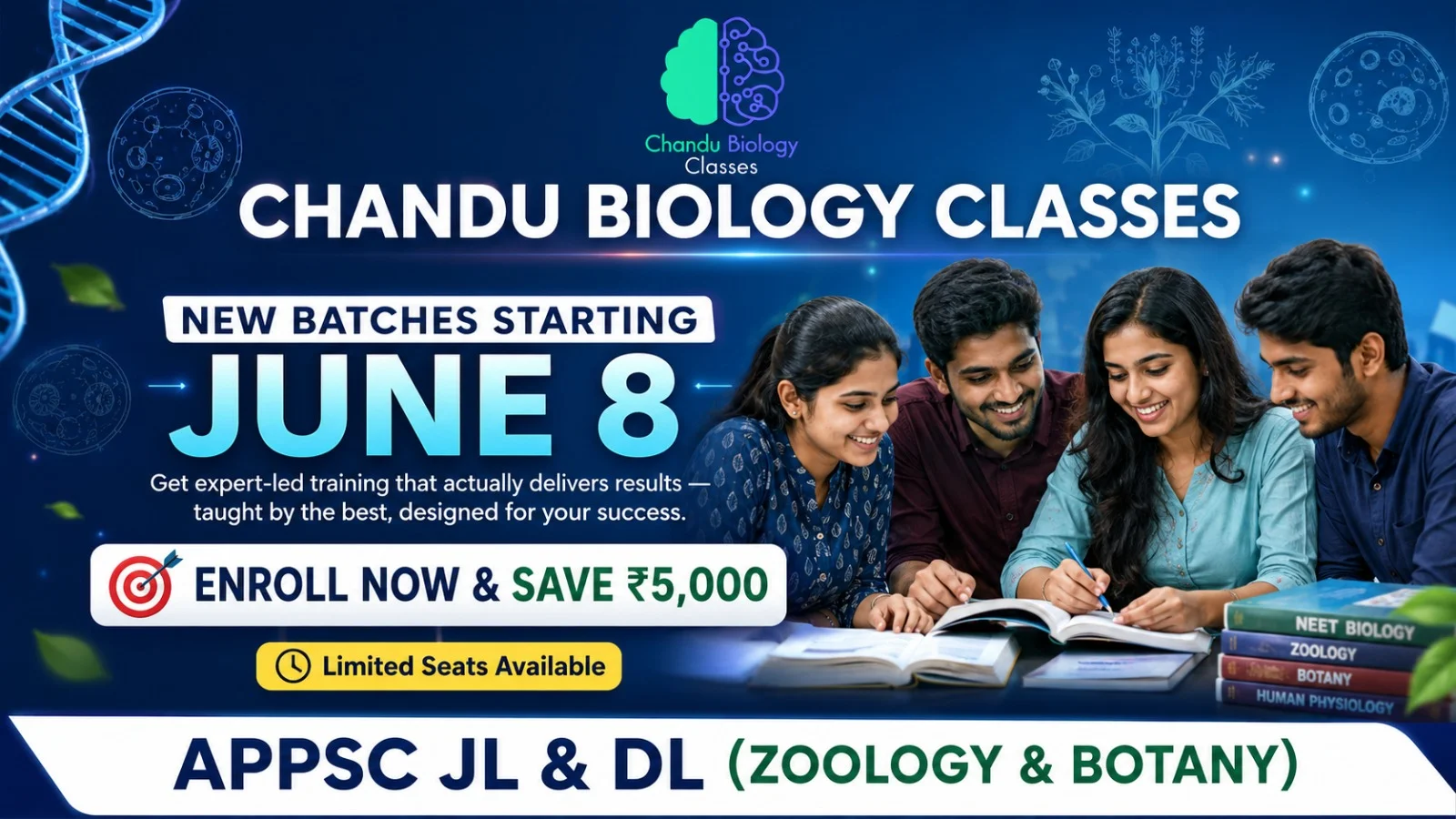
Chandu Biology Classes has established itself as one of the most focused and results-oriented coaching institutes for APPSC Junior Lecturer Life Sciences in Andhra Pradesh. The institute’s expertise spans Zoology, Botany, and related biological sciences — which means students preparing for APPSC JL Zoology receive coaching that is both subject-deep and exam-strategy-sharp.
What Makes Chandu Biology Classes the Right Choice for APPSC JL Zoology
PG-Level Teaching Depth The APPSC JL Zoology Paper 2 demands Master’s-level knowledge across 11 major units. Chandu Biology Classes delivers coaching at exactly this level — not a simplified version, not a shortcut approach, but actual PG-standard teaching that prepares you for whatever the exam throws at you.
Complete Syllabus Coverage Every one of the 11 units — from General Concepts and Non-Chordata all the way through Immunology — is covered systematically. No topic is left out. No shortcut is taken.
Exam-Pattern Focused Delivery Faculty at Chandu Biology Classes are experienced in translating deep subject knowledge into objective-type examination performance. They teach you not just what to study but how to approach MCQs at PG standard, including elimination techniques, common traps, and time management under the CBT format.
Dedicated Study Material Students receive well-structured, exam-aligned study material that maps directly to the official APPSC JL Zoology syllabus. This means no time wasted hunting for resources from multiple sources.
Flexible Learning Modes to Suit Every Aspirant Whether you are in Visakhapatnam, Kurnool, Guntur, or anywhere else in Andhra Pradesh, Chandu Biology Classes makes professional coaching accessible through two modes:
- 🖥️ Online Classes: Rs. 25,000
- 🏫 Offline Classes: Rs. 30,000
This pricing structure ensures that serious aspirants across all economic backgrounds and geographies can access quality coaching for one of Andhra Pradesh’s most competitive government job exams.
Application Process – How to Apply for APPSC JL Zoology
For aspirants who are not yet aware of the application process, here is a quick walkthrough:
- Register OTPR: First-time applicants must register on psc.ap.gov.in through One Time Profile Registration (OTPR) to obtain a User ID. This is NOT the application — it is just registration.
- Login and Apply: Using the OTPR User ID and password, log in and navigate to Online Application Submission. Click on the relevant notification and fill in Post Code 14 (Zoology).
- Fill Application Details: Include local/non-local status, white card details, post preferences, zone preferences and examination centre.
- Pay Fee and Submit: Application processing fee is Rs. 250/-. Examination fee is Rs. 120/- (exempt for SC, ST, BC, PBDs, Ex-Servicemen, white card holders and unemployed youth). Pay online and click Save & Submit.
- Corrections: Available for 7 days after the last application date (except Name, Fee and Age Relaxation fields). Correction charges: Rs. 100/- per change.
Frequently Asked Questions (FAQs) – APPSC JL Zoology
Q1. How many vacancies are available for APPSC JL Zoology in 2024? As per Notification No. 17/2023, there are 20 vacancies for Junior Lecturer in Zoology across all four zones of Andhra Pradesh.
Q2. Is NET compulsory for APPSC JL Zoology? Yes. NET/SLET is mandatory for APPSC JL Zoology. The only exemption is for candidates who hold a Ph.D. degree awarded in compliance with UGC (Minimum Standards and Procedure for Award of Ph.D. Degree) Regulations, 2009.
Q3. What is the salary for APPSC Junior Lecturer Zoology? The pay scale is Rs. 57,700 – Rs. 1,82,400 under Academic Level 10 as per the Revised UGC Pay Scale 2016.
Q4. What is the age limit for APPSC JL Zoology? 18 to 42 years as on 01/07/2023. Relaxations are available for SC/ST/BC (5 years), EWS (5 years), PBDs (10 years), Ex-Servicemen, and regular AP government employees.
Q5. What is the total marks for APPSC JL Zoology written exam? The total marks for the written exam are 450 — Paper 1 (General Studies) carries 150 marks and Paper 2 (Zoology) carries 300 marks.
Q6. Is there negative marking in APPSC JL Zoology exam? Yes. For every wrong answer, one-third (1/3rd) of the marks allotted to that question will be deducted. Unattempted questions carry no penalty.
Q7. Is local reservation applicable for APPSC JL Zoology? No. Local reservation is not applicable. Selection is made on state-wide merit. Zone allotment is based on the preference given by the candidate at the time of certificate verification.
Q8. Can I prepare for APPSC JL Zoology and GATE Life Sciences at the same time? Yes, and it is one of the smartest dual-preparation strategies available. Both exams share heavy overlap in Cell Biology, Genetics, Physiology, Ecology and Immunology. Chandu Biology Classes specifically accommodates students pursuing both exams simultaneously.
Q9. Which unit is most important in APPSC JL Zoology Paper 2? Based on syllabus depth and previous patterns, Cell Biology, Genetics, Non-Chordata (especially Parasitology), Physiology, and Immunology are consistently the most heavily tested sections.
Q10. What is the fee structure at Chandu Biology Classes for APPSC JL Zoology coaching? Chandu Biology Classes charges Rs. 25,000 for online coaching and Rs. 30,000 for offline coaching for APPSC JL Zoology preparation.
Q11. Is there a Computer Proficiency Test (CPT) for APPSC JL Zoology? Yes. After the written examination, shortlisted candidates must appear for a Computer Proficiency Test (CPT). Final selection is based on the written exam merit followed by CPT.
Q12. Does Chandu Biology Classes cover Paper 1 (General Studies) as well? Yes. Preparation for Paper 1 General Studies and Mental Ability is integrated into the coaching program at Chandu Biology Classes, ensuring students are not left unprepared for those critical 150 marks.
Q13. What happens if I fail to appear in one paper? Appearance in both papers is compulsory. Absence in any one paper leads to automatic disqualification from the recruitment process.
Q14. Can candidates from other states apply for APPSC JL Zoology? Yes, candidates from other states can apply. However, they are not entitled to fee exemption or any reservations. They must pay the full examination fee of Rs. 120/- along with the processing fee of Rs. 250/-.
Conclusion: Your APPSC JL Zoology Selection Starts With the Right Preparation
The APPSC Junior Lecturer Zoology exam offers something increasingly rare — a permanent, respected government position with excellent pay, career security, and the opportunity to shape the lives of thousands of students in Andhra Pradesh’s degree colleges.
With 20 vacancies and a rigorous PG-standard examination, the path to selection is demanding but absolutely achievable for candidates who prepare with the right strategy, the right resources, and the right guidance.
You now have the complete official syllabus. You know the exam pattern. You understand the vacancy distribution. The only thing that remains is structured, expert-led preparation — and that is exactly what Chandu Biology Classes delivers.
With online coaching at Rs. 25,000 and offline coaching at Rs. 30,000, professional preparation for APPSC JL Zoology has never been more accessible. Whether you are a fresh PG graduate stepping into the competitive exam arena for the first time, or an experienced aspirant looking to finally crack the selection, Chandu Biology Classes has the syllabus coverage, the teaching depth, and the exam strategy to take you there.
Do not wait for the next notification to start preparing. The students who crack APPSC JL Zoology are the ones who start early, stay consistent, and learn from the best.
Join Chandu Biology Classes today. Your government lecturer career in Zoology starts here.
Disclaimer: The information provided in this article, including syllabus details, vacancy figures, eligibility criteria, fee structures and examination patterns, has been compiled from publicly available sources on the internet, primarily based on APPSC Notification No. 17/2023. While every effort has been made to ensure accuracy and completeness, readers are strongly advised to verify all details directly from the official APPSC website (psc.ap.gov.in) before making any academic or financial decisions. Chandu Biology Classes bears no responsibility for any discrepancies arising from changes in official notifications, government orders or recruitment rules after the publication of this article.
